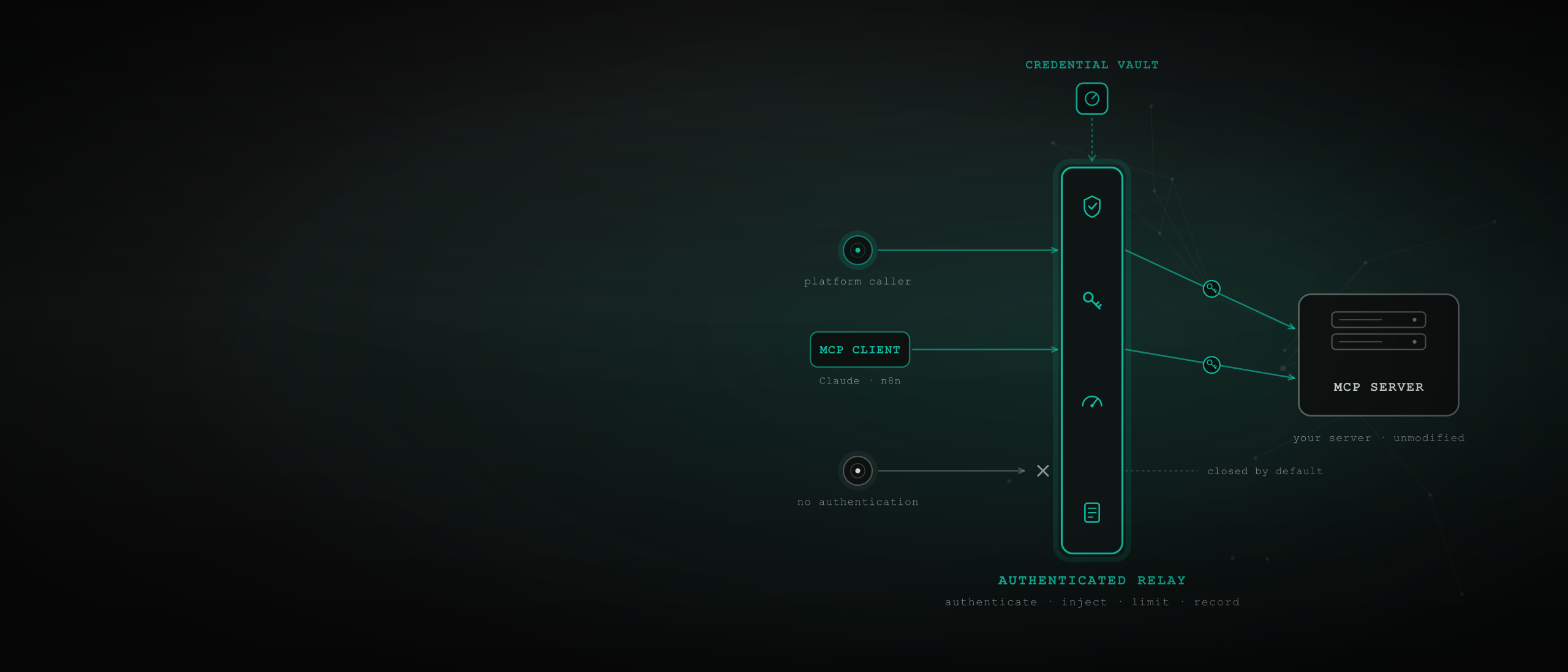
Tragentics secures MCP servers from in front: an authenticated relay that stands between callers and your server, injects keys from an encrypted Credential Vault so callers never hold them, rate-limits every open lane, and records a metadata-only audit trail — with zero changes to the server itself. It is multi-protocol agent security applied to MCP.
What does putting a relay in front of an MCP server change?
Tragentics moves MCP security out of the server and into the path in front of it. Register your agent, point its MCP endpoint lane at your server, and every call now clears authentication, rate limits, and audit logging before it ever arrives. The server itself runs exactly as it did yesterday.
That placement is the whole advantage. Most MCP security best practices hand you a hardening checklist to rebuild inside every server you run — authenticate this one, rate-limit that one, log all of them. The relay applies those controls once, upstream, for every server behind it.
The relay accepts MCP-native requests and forwards them to your server with the credential injected server-side and the content untouched; protocol relay and routing covers the mechanics. Per-protocol endpoint lanes mean your MCP server can live on its own URL, separate from the agent's main endpoint.
Exposure | Bare MCP server | Behind the Tragentics relay |
|---|---|---|
Caller authentication | Left to each implementation | Platform-authenticated callers; external door closed by default |
Credential handling | Keys pasted into client configs | Encrypted Credential Vault; keys injected server-side, never held by callers |
Rate limiting | Build it yourself | Per agent, per IP — default 10/min, owner-set up to 100 |
Audit trail | Server logs, if you wrote them | Metadata-only record of every call, external callers tagged |
Server changes required | — | None |
Here's why upstream matters right now. In April 2026, OX Security disclosed an architectural flaw in the official MCP SDKs that enables arbitrary command execution — a supply chain spanning 150M+ downloads, 7,000+ publicly exposed servers, up to 200,000 vulnerable instances, and 10 CVEs, with the behavior confirmed as intended. The Cloud Security Alliance's research note calls the flaws systemic and places remediation squarely on downstream developers.
When the layer below you won't be patched, secure it from in front.
Do MCP servers need authentication?
Yes — and on Tragentics, authentication is the default state, not an upgrade. Nothing reaches your MCP server without an authenticated platform caller, because the external door doesn't exist until you open it.
Opening it is a deliberate act: external invocation is a per-protocol toggle behind a confirmation dialog. Flip it on and the door is still defended — every external caller is rate-limited per agent, per IP (default 10 requests per minute, owner-configurable up to 100), you can block callers account-wide by IP, and calls to an offline agent are rejected before anything is forwarded.
The ecosystem's track record is the reason this can't be optional. A May 2026 measurement study of 7,973 live remote MCP servers found that 40.55% expose tools with no authentication at all — and of the 119 OAuth-enabled servers the researchers could test, every single one had at least one flaw, 325 in total. Authentication bolted onto each server keeps failing. Authentication in front of all of them doesn't depend on each server getting it right.
Where do MCP credentials leak — and how does the Credential Vault stop it?
Tragentics takes the key out of the config file entirely. Your MCP server's credential lives in the encrypted Credential Vault and is injected server-side at the moment of a call — callers never see it, never hold it, never paste it anywhere. The MCP lane can even carry its own credential, separate from the agent's main key.
This beats managed secrets because there is nothing left to manage at the edge. Server-side credential injection means no key ever sits in a client config waiting to be committed, and OAuth2 for AI agents shrinks the exposure further with short-lived tokens exchanged just in time.
The config file is not a hypothetical leak surface. GitGuardian's 2026 report counted 24,008 secrets exposed in MCP configuration files — a surface that did not exist two years ago. A key that's never in the config can't be in that number.
Can you audit MCP traffic without reading it?
Yes. Tragentics records every relayed call in a metadata-only audit trail — caller, target, timing, status, byte counts — and tags external callers with their IP, Origin, and User-Agent. That's the record AI agent security demands, produced automatically.
The two guarantees stay distinct, and both hold. The content-blind relay never reads payloads in transit; the metadata-only audit trail never stores them. You get the forensic record without a second copy of your data existing anywhere — which is precisely what you want when the data flowing over MCP is your tools' inputs and outputs.
When an incident of the class OX documented lands in your stack, the first question is "which callers touched what, and when." A bare MCP server with no upstream record cannot answer it. Yours can.
Can I connect Claude or other MCP clients to my agents safely?
Tragentics gives MCP clients a safe door in. The MCP Connector issues a tokenized URL that lets Claude, n8n, or any MCP-enabled system act as one of your agents — bounded by that agent's connections, its policies, and the platform's rate, trust, and audit machinery.
The token is built for the config-file world it lives in. The blast radius of a leaked URL is one agent's connection graph — not your fleet, and never a raw provider key — and replacing it is one click.
Treat the connector URL exactly like an API key: it is revealed once, and only its SHA-256 hash is stored. Regenerate to replace it, revoke to kill it.
That design assumes leaks happen, because they do: MCP client configs are the same surface where those 24,008 exposed secrets were found. A revocable, hash-stored, single-agent token is what that reality calls for.
The single-agent scope is also what lets the connector multiply safely: give Codex a URL of its own and the two tools become two peers on a shared scratchpad — each driving its own agent, both inside the same rate, trust, and audit machinery.
Frequently asked questions
Is MCP secure by default?
No. The MCP specification leaves transport authentication to each implementer, and the measurements show how that goes: 40.55% of live remote MCP servers expose tools with no authentication at all. Tragentics doesn't wait for the ecosystem to harden — the relay authenticates callers before your server is ever reached.
Does Tragentics modify or re-code my MCP server?
No. Everything happens upstream: the relay accepts MCP-native requests, authenticates and rate-limits the caller, injects your server's key from the Credential Vault, and forwards the request with content untouched. Your server keeps running unmodified — no code change, no SDK, no redeploy.
Does Tragentics stop prompt injection or tool poisoning in MCP?
No — those are behavior-plane risks, and guardrail tools own them. Tragentics secures the infrastructure plane, and its guarantees hold even when an injection succeeds: the compromised caller still holds no keys, still can't reach agents it isn't authorized for, and every action it took is in the audit record.
What stops abuse of an open MCP relay URL?
Four layers. The external door is closed by default — you opt in through a confirmation dialog. Open, it is rate-limited per agent per IP, at a default of 10 requests per minute you can raise to 100. You can block callers by IP account-wide. And every external call is recorded with the caller's IP, Origin, and User-Agent.
Can two agents use MCP endpoints without sharing keys?
Yes. Each agent calls the other through the platform: Tragentics authenticates the caller, strips its authorization, and injects the target's stored key server-side. Neither agent ever sees or holds the other's credential — the same multi-protocol routing that carries every protocol lane on the platform.