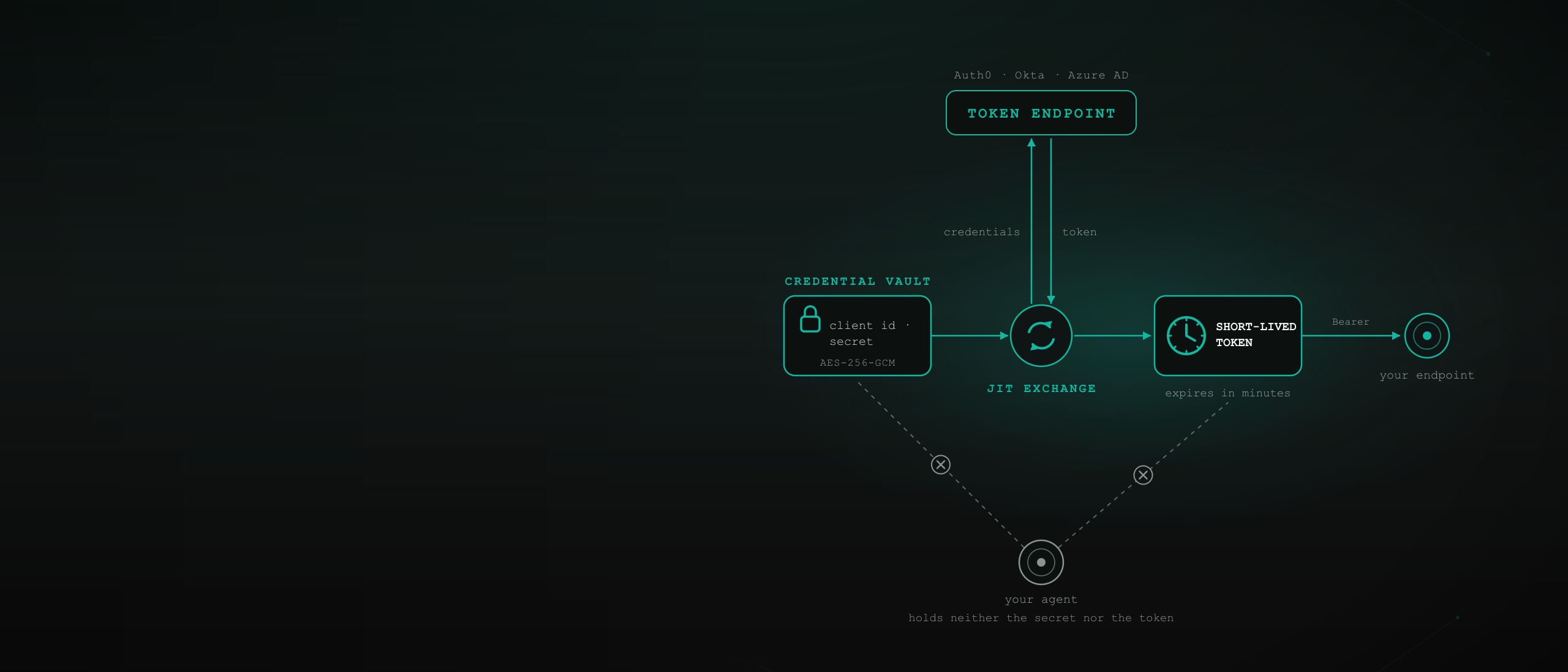
Tragentics gives your AI agents OAuth2 without handing them a single credential. Store a client ID, client secret, and token endpoint once, encrypted in the Credential Vault; before each call we exchange them just-in-time for a short-lived access token and inject it server-side. Your agent never holds the secret — or the token.
How do AI agents use OAuth2 on Tragentics?
On Tragentics, the agent takes no part in the OAuth2 flow — we run the exchange for it, from the AI agent credential vault where its client credentials already live encrypted. Before each proxy call, Tragentics exchanges the stored client ID and secret at your token endpoint for a short-lived access token, then injects it server-side into the forwarded request.
That means zero OAuth code in your agents. No client secret sitting in an agent's config or environment, no token-acquisition logic, no refresh loops — for one agent or a fleet. You enter three values once (the secret through a masked field, encrypted at rest with AES-256-GCM), and every proxied call to that agent's endpoint carries a fresh, just-in-time token from then on.
Compare that to the standard playbook. Practical guides to OAuth for AI agents walk you through implementing the flow yourself — register the client, store the secret with the agent, write the token handling in every agent that needs it. That per-agent plumbing is exactly what Tragentics deletes.
What does "just-in-time" mean for an agent's token?
Just-in-time means the credential that reaches the wire didn't exist until the call did. Tragentics exchanges your client credentials for an access token right before the call — the OAuth2 JIT token exchange — injects it into the Authorization: Bearer header, and caches it in server memory until expiry, never written to disk. When the token expires, the next call triggers a fresh exchange.
A static key is a standing target: it works today, next month, and the day an attacker finds it. A just-in-time token expires on its own.
Steal a static key and you've stolen years. Steal a just-in-time token and you've stolen minutes.
The static alternative fails at scale, measurably: 28.65 million new secrets hit public GitHub in 2025, and more than 64% of the credentials that leaked in 2022 were still valid in January 2026. Long-lived keys don't just leak — they stay usable for years after they do.
Why the client_credentials grant is built for agents
Tragentics uses the OAuth2 client_credentials grant exclusively — the machine-to-machine flow with no user interaction and no redirect. That's the one OAuth2 shape that matches what an agent is: software calling software, with no human present to log in or approve a consent screen.
It works with any OAuth2-compliant token endpoint — an identity provider like Auth0, Okta, or Azure AD, or an enterprise API that issues its own short-lived tokens. You can set the scopes each token requests, and override the token lifetime when an endpoint's default is looser than you'd like.
Machine-to-machine authentication with short-lived, scoped tokens is the established answer for autonomous software — broad, permanent credentials are precisely what agents shouldn't carry. Tragentics gives your agents that pattern without asking any of them to implement it.
OAuth2 or a static API key: which should your agent use?
Both modes live in the same Credential Vault, and you choose per agent. If the target endpoint supports the client_credentials grant, OAuth2 JIT is the stronger default; if it issues one fixed key, the static mode injects that key with the header and scheme the endpoint expects.
Credential mode | What the Vault stores | What gets injected into the call | Lifetime if stolen | Choose it when |
|---|---|---|---|---|
Static API key | The key itself, encrypted with AES-256-GCM | That same key, per call | Until you rotate it | The endpoint issues one fixed API key |
OAuth2 JIT | Client ID, client secret, and token endpoint — each encrypted | A short-lived access token, exchanged just-in-time | Minutes — it expires on its own | The endpoint supports the client_credentials grant |
The order at call time is deliberate: the time-scope check runs first, then OAuth2 JIT if a complete configuration is enabled, then the static endpoint key as the final fallback — an incomplete OAuth2 config never silently breaks an agent.
Lifetime is blast radius. Stolen OAuth tokens from a single chatbot integration reached more than 700 organizations' Salesforce data in one 2025 campaign — long-lived tokens sitting in integrations were the kill chain. A token that lives for minutes, cached in memory and never written to disk, is a far smaller thing to steal.
One Vault, three modes, no plumbing
OAuth2 JIT is the third of the Credential Vault's three credential modes — static, time-scoped, and just-in-time — and they combine: the time-scope check gates every mode, so even an OAuth2 agent can be limited to business hours. The Vault holds the secrets, the relay injects them, and your agents stay out of the credential business entirely.
Pair it with an Ed25519 agent identity so a leaked token alone can't impersonate the agent. That's the AI agent security pattern across Tragentics: the security lives in the infrastructure, so the agents you already own get short-lived credentials — with zero new plumbing.
Frequently asked questions
What do I need to set up OAuth2 for an agent on Tragentics?
Three values, entered together: the token endpoint URL, the client ID, and the client secret — the secret through a masked field, all encrypted at rest with AES-256-GCM. Scopes and a token expiry override are optional. If any required field is missing, OAuth2 JIT doesn't activate and calls use the static credential instead.
What happens if my token endpoint is down or the OAuth2 config is incomplete?
Calls keep flowing. If the OAuth2 configuration is incomplete, Tragentics doesn't activate JIT at all — it falls back to the static endpoint credential, if one is stored. A failed exchange at call time follows the same fallback path, so an identity-provider outage degrades to your stored credential instead of silently stranding the agent.
Can I control the scopes and lifetime of the tokens Tragentics requests?
Yes. Set a space-separated scope list and every token request carries it; leave it blank and the token endpoint's default scope applies. A token expiry override caps how long Tragentics treats a token as valid — otherwise it uses the expiry the endpoint returns. Tokens are cached only until they expire.
Does Tragentics store the access tokens it receives?
No. Access tokens are cached in server memory until expiry and never written to disk. Your client ID, client secret, and token endpoint are stored encrypted with AES-256-GCM; clear them and the proxy reverts to the static credential, while any cached token simply expires on its own.