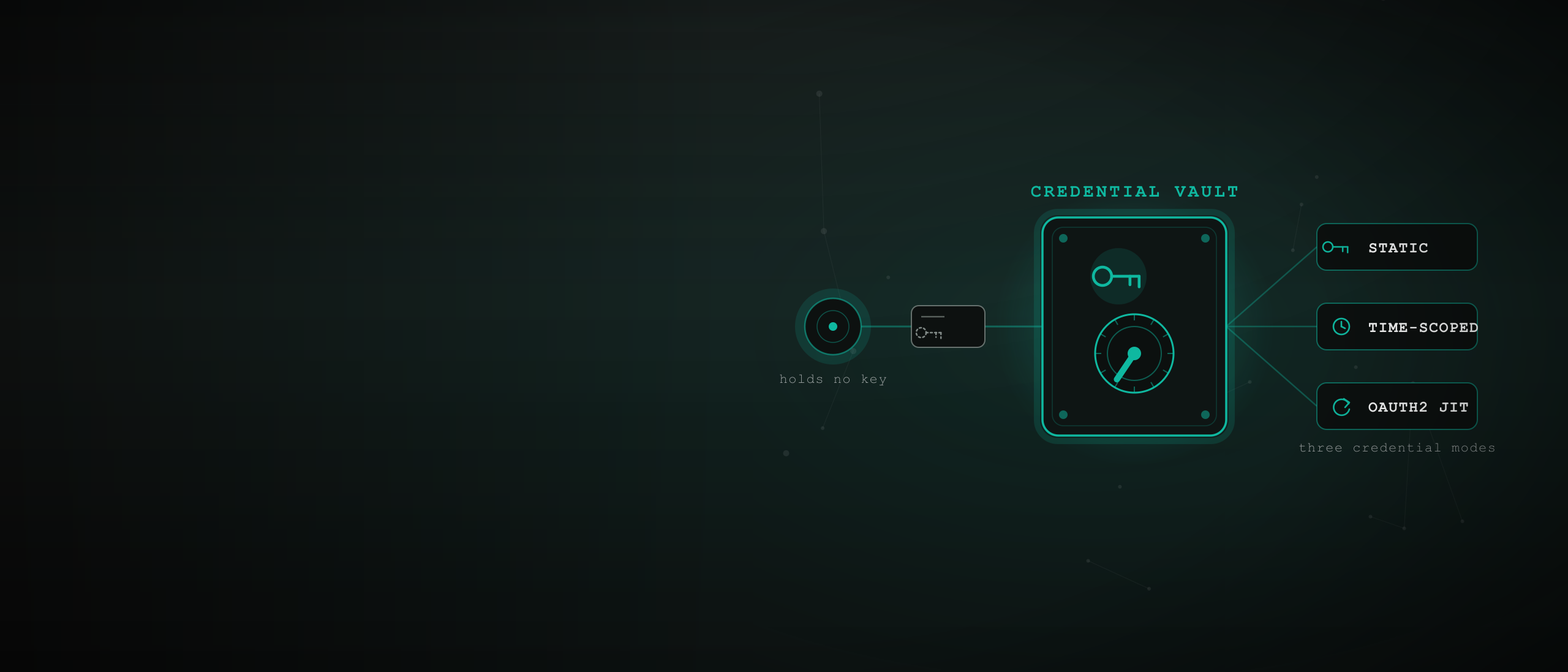
An AI agent credential vault is a system that stores the API keys, tokens, and secrets an AI agent needs to call external services, then releases them only at the moment of a call — so the credentials never sit in the agent's code, prompt, memory, or logs, where they can leak or be stolen.
Tragentics is the AI agent security platform that injects keys from an encrypted Credential Vault so agents never hold them. The vault isn't a component you run beside your agents — it's built into the connection, so a key is encrypted the moment it lands and injected server-side only at the instant of a call.
What is an AI agent credential vault?
An AI agent credential vault is a centralized service that holds an agent's secrets and releases them programmatically at runtime, instead of embedding them where the agent — or an attacker reading the agent's context — can see them. It is the agent-native descendant of the secrets manager, rebuilt for software that authenticates on its own, thousands of times an hour, with no human at the keyboard.
The distinction from a human password manager is the entire point. A password manager is built for copy-paste: a person unlocks it, reads a secret, and pastes it somewhere. An agent credential vault is built for programmatic retrieval, and the vendors defining the category agree that an agent's credentials should never appear in plain text in its code, logs, or prompt context. Infisical's Agent Vault frames it as a proxy that agents route requests through; Scalekit and Auth0 call the pattern a "token vault"; industry explainers describe the same need. The shared promise underneath all of them: the agent uses a secret it does not keep.
Why do AI agents need a credential vault?
AI agents need a credential vault because the alternative — handing each agent its own long-lived key and trusting it to hold it safely — is the single most common way secrets escape, and agents multiply that exposure at machine speed. An agent's key tends to be over-permissioned, long-lived, and reachable from the same context an attacker can manipulate.
The scale of the leak problem is now measured in the tens of millions. GitGuardian counted 28.65 million new hardcoded secrets pushed to public GitHub in 2025 alone — a 34% jump and the largest on record — with 24,008 of them sitting in MCP configuration files. Roughly 64% of the secrets found valid in 2022 were still valid four years later, so a leaked key stays dangerous for years. And there are far more machine identities to leak from than human ones: CyberArk reports machine identities now outnumber humans by more than 80 to 1.
This is also where the behavior plane and the infrastructure plane meet. A guardrail can watch what an agent says and block a prompt-injection attempt — but it cannot protect a key the agent is already holding, and a stolen credential used correctly looks like normal traffic. The Salesloft Drift breach showed the shape of it: stolen OAuth tokens let intruders impersonate a trusted app and export data from more than 700 organizations. A credential vault answers the part of the problem guardrails structurally cannot: it removes the held key entirely.
Credential vault vs. secrets manager vs. PAM: which do you need?
The right tool depends on one question — who ends up holding the secret. A secrets manager centralizes storage but usually still hands the key to the code that asks for it; a credential proxy or token vault keeps the key out of the agent by injecting it; a PAM vault governs privileged access for both humans and machines. All of them help, and all of them share one gap: most were adapted to agents, not built for them, and most are infrastructure you stand up and operate yourself.
Approach | What it is | Deploy & run it yourself? | Caller agent ends up holding the key? | Agent identity + audit unified with the vault? | Multi-protocol agent transport? |
|---|---|---|---|---|---|
Secrets manager — HashiCorp Vault | Central secrets engine, dynamic secrets | Yes | Often — unless a sidecar injects | Partial | No |
Credential proxy — Infisical Agent Vault | Self-hosted proxy that attaches creds to requests | Yes | No — proxy injects | Limited | HTTP only |
Stores & brokers OAuth tokens for agents | Integrate the SDK | No — brokered | Partial | No | |
Password manager — Bitwarden (agentic) | Injects creds into the workflow run | Integrate | No — injected | No | No |
PAM vault — 12Port | Privileged-access vault issuing agent creds | Yes | Depends on config | Identity yes | No |
Tragentics Credential Vault | The credential layer of the relay itself | No — part of the connection | Never | Yes — one system | Yes — MCP, A2A, OpenAI, ANP, ACP |
If you already run heavy identity infrastructure and want agents to draw from it, a secrets manager or PAM vault fits. If you want the key out of the agent without that weight, a proxy or token vault is closer. Tragentics sits in the last row — a vault that isn't a separate system to draw from at all, but part of the call path itself; the next section walks through what that means in practice.
How Tragentics's Credential Vault works: a key your agent never holds
On Tragentics, the calling agent never holds the key it calls with. You store a credential once; it's encrypted at rest; and at the exact moment of a call, the platform injects the target's stored credential server-side into the one outbound request — and nowhere else. The calling agent's own authorization header is stripped and replaced with the target's key before a single byte leaves the platform, so two agents connect without ever meeting each other's secrets.
That is the wedge between a credential vault you use and one you travel through. A vault is normally a place your code reads a key out of — the app still ends up holding it. Here, the Credential Vault is part of the relay every call already transits, so the secret is only ever assembled into the request bound for its rightful endpoint and is never exposed to the calling agent, the dashboard, or you. There's no vault to stand up and no proxy to wire; it's a property of the connection. The full mechanism is covered in server-side credential injection.
How your keys are protected at rest: AES-256-GCM
Every secret you store on Tragentics is encrypted at rest with AES-256-GCM — API keys and endpoint URLs alike. It is authenticated encryption, so a tampered value doesn't quietly slip through; it fails to decrypt. Each stored value carries its own unique initialization vector and an authentication tag that detects any tampering.
The platform uses two models chosen by purpose. Secrets that must be replayed to an upstream API are sealed with reversible AES-256-GCM and decrypted only in server memory, only at the moment of a call. Secrets that only ever need to be checked — the keys an agent presents to prove who it is — are stored as one-way hashes that can be matched but never read back. If a value never needs recovering, it can't be. This is the baseline a SOC 2 or ISO 27001 auditor expects and most agent setups skip; the full model is documented in the credential security model, and the day-to-day discipline of it in AI agent credential management.
The three ways a credential can behave: static, time-scoped, and JIT
A credential on Tragentics can behave in three ways, and they can be combined. A static key is the simplest; a time-scoped key only works inside a window you define; and OAuth2 client credentials are exchanged just-in-time for a short-lived token. The point of the last two is to shrink an attacker's window from years to minutes.
Mode | How it behaves | Best for |
|---|---|---|
Static API key | A fixed key, stored encrypted, injected into the outbound request with the header and auth scheme the target expects | A stable third-party API key you set once |
Time-scoped | The key injects only inside an allowed window — business hours, or scheduled call windows only; outside it, proxy calls to the agent are rejected | Limiting a key to when the agent should actually be working |
OAuth2 client credentials (JIT) | Stored client credentials are exchanged just-in-time for a short-lived token, cached in memory until expiry and never written to disk | APIs that issue short-lived OAuth2 access tokens |
A key that sits in a vault forever is a standing target; a time-scoped credential is dead weight to an attacker outside its window, and a just-in-time token expires on its own. The mechanics are in time-scoped credentials and OAuth2 credentials; the full just-in-time story — client credentials in, short-lived tokens out, zero OAuth code in your agent — is in OAuth2 for AI agents.
Secretless agents: you can't leak a key you never had
A secretless agent is one that never possesses the credential it calls with — and because the caller holds nothing, there is nothing for it to leak, log, or over-reach with. A credential vault is what makes an agent secretless in practice; the security industry states the principle plainly:
Applications cannot leak what they don't have.
Most secretless approaches reach that state through heavy workload-identity infrastructure — SPIFFE identities, kernel modules, sidecars — that you deploy and maintain. Tragentics reaches it with no infrastructure change at all: the relay injects from the Credential Vault, so an agent is secretless on its very first call, before you harden anything, and it works with any external API — including third-party SaaS your infrastructure doesn't control. Over-privileged AI systems ran a 4.5× higher incident rate than least-privilege ones; the surest way to hold that radius at zero is to make sure the caller never has the key to begin with.
What the vault sees, and what it never sees
The Credential Vault handles your key but never reads your data — two separate guarantees that are easy to conflate. It decrypts and injects the credential for a single request, and it never inspects the request or response payload passing through. This is the difference between a vault and a copy of your traffic.
What flows through | What the Credential Vault does with it |
|---|---|
The stored credential | Decrypts it in server memory and injects it into the one outbound request — present for that request only |
The request & response payload | Never reads it — content-blind by design; on buffered lanes the platform holds opaque bytes only to deliver them, recording just the byte count |
The audit record | Metadata only — caller and target identity, status, latency, byte count; never the payload, the URLs, or the key |
Responses, logs, and the dashboard | The key is never shown — you see only that a key is set, never the value |
Because Tragentics routes every call through a content-blind relay and records a metadata-only audit trail, the vault can prove every call happened without ever becoming a second copy of your sensitive data — evidence of what was called, by whom, and when, which you can follow in audit without storing the payload.
That evidence supports your record-keeping and traceability obligations. It is not a compliance certification, and Tragentics never inspects payloads to produce it.
One vault across every protocol and topology
The same encryption and the same server-side injection run on every call your agents make and across every protocol Tragentics relays. There is no weaker lane where the rules quietly relax. A2A, MCP, OpenAI, ANP, and ACP each carry their own sealed, per-protocol credential behind one permanent agent identity, and the model is identical whether a call is direct, broadcast to a group, load-balanced across a pool, or fired on a schedule.
Uniformity is what keeps a credential model correct at scale. At thousands of agents and thousands of keys, one fragmented integration that forwards a key or lets the caller hold the secret is all it takes to become the incident. Running one vault across every protocol and connection — rather than a dozen half-secure integrations that each reinvent auth — is how the guarantee holds. It's also what lets two agents connect without sharing a credential no matter how they talk to each other.
Where the Credential Vault fits in AI agent security
The credential vault is the identity-and-credentials corner of the infrastructure plane — the half of AI agent security concerned with what an agent is and touches, rather than what it decides and says. It sits alongside the other infrastructure-plane concerns: agent identity, secure transport, and audit.
It does not replace the behavior plane, and it isn't meant to. What a credential vault contributes is the guarantee the behavior plane can't make: that even a perfectly manipulated agent has no key to surrender.
A credential vault doesn't replace behavior-plane defenses like guardrails and runtime monitoring — the two planes cover different risks, and a complete strategy needs both.
On Tragentics the vault doesn't stand alone either — it shares one system with agent identity, proven by per-call Ed25519 signatures and durable verified agent pairs, and compared against the certificate model in Ed25519 vs. mTLS. Seen next to the point tools and platforms in the market, that integration is the difference. The operational frame for that whole corner is treating agents as non-human identities — one permanent ID, scoped keys, tracked rotation, and a per-identity audit trail for every agent you register.
Frequently asked questions
What is an AI agent credential vault? It's a system that stores the API keys, tokens, and secrets an AI agent needs and releases them only at call time, so the credentials never live in the agent's code, prompt, memory, or logs. The agent uses a secret it never keeps, which removes the most common way keys leak.
How is a credential vault different from a secrets manager like HashiCorp Vault? A secrets manager centralizes storage, but the agent usually fetches the key and then holds it — once retrieved, the secret lives in the agent's memory and the vault can no longer protect how it's used. A credential vault built for agents keeps the key out of the agent by injecting it at call time instead of handing it over.
Can an AI agent use an API key it never sees? Yes. Tragentics injects the target's stored credential server-side into the outbound request at the moment of the call, and strips and replaces the calling agent's own authorization first. The agent reaches the API with a key it never receives, stores, or sees.
Are AI agent credentials encrypted at rest? On Tragentics, yes — every stored secret is encrypted at rest with AES-256-GCM, authenticated encryption that fails closed if a value is tampered with. Keys that only need checking are stored as one-way hashes instead, so they can be matched but never read back.
What is a secretless AI agent? A secretless agent never possesses the credential it calls with. Because the caller holds nothing, there's nothing to leak, log, or steal from it — the industry principle is that applications can't leak what they don't have. A credential vault that injects at call time is what makes an agent secretless.
Does a credential vault stop prompt-injection credential theft? It removes the target. A guardrail tries to detect the injection; a credential vault ensures that even a manipulated agent has no stored key to exfiltrate, because the key was never in the agent's reach. The two work on different planes and are strongest together.
Does it work with OpenAI, Anthropic, and MCP servers? Yes. Tragentics injects using whatever header and auth scheme the target expects — an x-api-key header for Anthropic, a bearer token for others — following the provider setups it already maps, and relays MCP, A2A, OpenAI, ANP, and ACP traffic for the agents you already own.
Do I have to deploy or run the vault myself? No. The Credential Vault is built into the connection, not a binary or proxy you stand up and operate. Store a credential once and it's encrypted, scoped, and injected from the first call — there's no separate vault infrastructure to deploy or maintain.