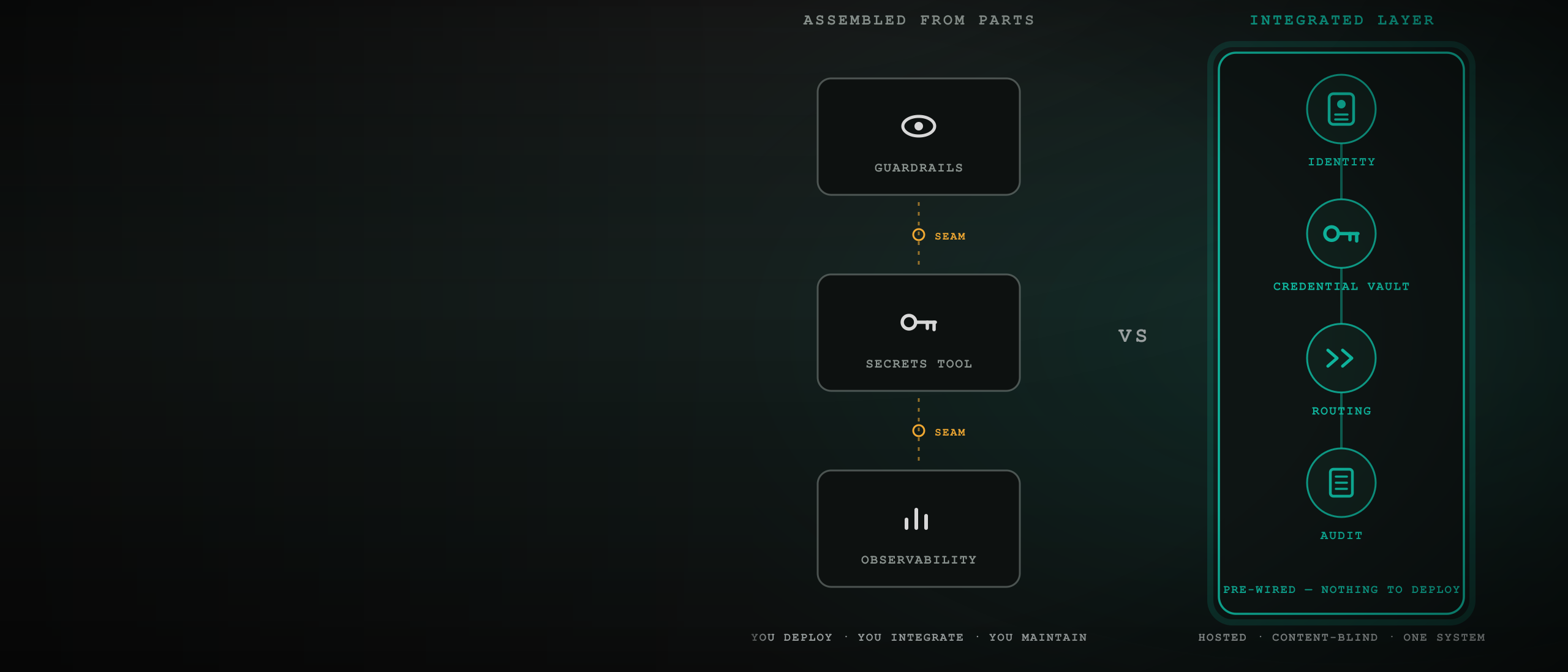
The AI agent security tools of 2026 sort into four categories: guardrail and governance platforms that inspect behavior, identity and secrets point tools you deploy yourself, observability suites that log everything, and the integrated infrastructure layer. Tragentics is the fourth — vault, identity, routing, and audit in one hosted, content-blind system.
Four kinds of AI agent security tools
Tragentics is the integrated infrastructure layer of AI agent security — identity, credentials, transport, and audit as one hosted system. The rest of the market sorts into three other categories, and the fastest way to a sound stack is knowing which plane each one secures before any demo starts.
Here's the map, with the column vendor pages rarely print: what you still need after you buy.
Category | What it secures | How it deploys | Reads payloads? | What you still need |
|---|---|---|---|---|
Guardrail & governance platforms — Zenity, Straiker, Obsidian | Behavior: prompts, tool use, runtime actions | SaaS plus agent instrumentation | Yes — by design | The infrastructure plane: vault, identity, transport, audit |
Identity & secrets point tools — Aembit, Akeyless, Infisical | One infrastructure slice each | You deploy and integrate it | No | The other slices, plus the integration work |
Observability suites — Datadog and peers | Telemetry: traces, dashboards, evals | SDK or agent instrumentation | Typically — payload logging | Enforcement; visibility isn't control |
Integrated infrastructure layer — Tragentics | Identity + credentials + transport + audit | Hosted relay — nothing to deploy | Never — content-blind | The behavior plane: testing and guardrails |
The gap this market exists to close is measurable and current: in Aembit's 2026 survey of 900+ practitioners, 80.9% of teams had agents in testing or production — and only 21.9% treated them as independent, identity-bearing entities.
What guardrail platforms do well — and what they can't hold
Tragentics deliberately does not inspect content — we run no inference and never read payloads — so the behavior plane belongs to the platforms built for it. Zenity covers agent security and governance from buildtime to runtime; Straiker red-teams agents and detects runtime threats, including MCP and tool-chain risk; Obsidian Security discovers and governs the agents already spreading through your SaaS estate.
For goal hijack, tool misuse, and memory poisoning, that inspection is exactly the tool you want. Buy it for that job.
What it can't do is hold your keys or prove a caller — the risks that never appear in content. We walked that boundary in the half prompt-injection tools can't see: possession problems don't have inspection solutions.
Point tools cover one row each — you assemble the rest
Tragentics ships the vault, identity, routing, and audit as one pre-wired system. The point tools each build one of those pieces — often excellently — if you deploy and run them. Aembit does workload IAM for agentic AI, with secretless access through identity infrastructure you operate; Akeyless unifies secrets and non-human identity management; Infisical offers open-source secrets management with an agent credential proxy.
The honest cost isn't any one tool — it's the assembly. Each is a deployment, an integration, and a maintenance surface, and credentials travel across every seam you create between them.
Point tools give you the parts. The seams between them are where keys travel.
The same survey finds 74% of practitioners say agents end up with more access than they need — least privilege leaks exactly where systems get hand-joined. If you already run a mature secrets estate, point tools extend it credibly. If you're starting from agents, you're signing up to build the layer we already run.
Observability shows you the incident — it doesn't stop it
Tragentics records a metadata-only audit trail as a side effect of routing: every call writes its line, and there is no path around the relay. Observability suites like Datadog go deeper on telemetry — model traces, dashboards, evaluations — and that depth has real uses we don't replicate.
Two structural differences decide what each is for. First, a control point versus a viewport: the relay can refuse a call; a dashboard can only show it to you.
Second, payload posture. Observability logging typically stores content, which quietly makes your monitoring stack another sensitive datastore. Our trail records who called whom, when, and how it went — never what was said — which supports your record-keeping obligations without creating a new thing to protect.
The integrated layer: one system, pre-wired, content-blind
Tragentics is the AI agent security platform that authenticates every agent, injects keys from an encrypted Credential Vault so agents never hold them, routes every call through a content-blind relay, and records a metadata-only audit trail — across platforms and protocols.
Integration is the product. Store a key once and it's vaulted. Register an agent and it has an identity. Connect two agents and the routing, rate limits, and audit line are already on the wire — the same motion that grants access is the one that secures and records it, with keys your agents never see doing the work.
Against assembly, that's the difference between an afternoon and a quarter. Against guardrails, it isn't a contest at all — different planes, division of labor. And when one agent's job turns critical, the trust dial climbs per agent to per-call cryptographic identity.
How to choose in 2026
Tragentics handles the infrastructure plane; choosing the rest starts from what your agents touch, not from feature lists. Agents reading untrusted content — web pages, inbound email, user chat — need a guardrail platform and injection testing behind it. A mature identity and secrets estate makes point tools a credible extension. And if you want the infrastructure plane handled without a build, that's the integrated layer.
Most fleets land in the same place: the integrated layer for infrastructure, a guardrail platform where content is the risk, and a test suite that treats both as falsifiable.
The floor is free to stand on. Tragentics has a free tier, and every agent on it starts with the Credential Vault, the content-blind relay, and the metadata-only audit trail already running. Bring the agents you already own — the security layer is the part you no longer have to build.
Frequently asked questions
What are the main categories of AI agent security tools?
Four: guardrail and governance platforms that inspect agent behavior (Zenity, Straiker, Obsidian), identity and secrets point tools you deploy yourself (Aembit, Akeyless, Infisical), observability suites that collect telemetry (Datadog and peers), and the integrated infrastructure layer — Tragentics — which ships identity, the Credential Vault, content-blind routing, and metadata-only audit as one hosted system.
Do I need both a guardrail platform and infrastructure security?
Usually, yes — they secure different planes. Guardrails inspect what agents decide and say; infrastructure secures what agents hold and touch. Neither can do the other's job: a guardrail can't hold your keys, and Tragentics never reads your payloads. The clean stack runs one of each, with nothing bought twice.
What's the difference between a secrets manager and an integrated agent security platform?
A secrets manager stores keys and hands them to your code, which then holds them — and it covers only that one slice. An integrated platform like Tragentics builds the vault into the transport: keys are injected server-side at call time so agents never hold them, and identity, routing, and audit arrive in the same system.
Is there a free way to start securing AI agents?
Yes. Tragentics has a free tier, and its security floor is on by default: credentials encrypted in the Credential Vault, calls routed through the content-blind relay, and a metadata-only audit trail from the first call. From there, per-call Ed25519 identity switches on per agent, when a job demands it.