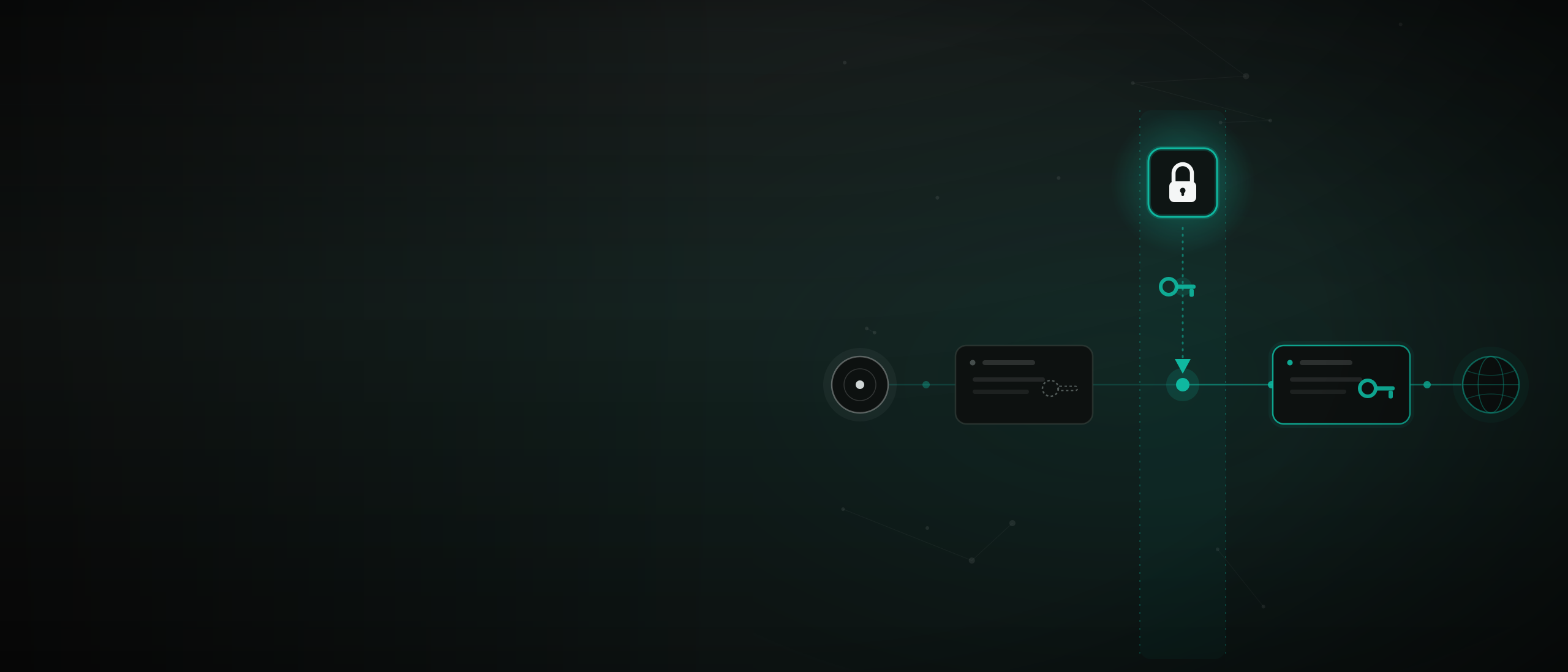
Yes. Tragentics injects a target agent's credential server-side into the outbound request at the exact moment of a call — so your agent reaches an API with a key it never receives, never stores, and never sees. Its own authorization is stripped and replaced with the target's, so two agents connect without ever meeting each other's secrets. Server-side injection is how a credential vault for AI agents hands a key to an API without ever exposing it.
Your agent calls with a key it never holds
On Tragentics, the agent making a call never holds the key it calls with. We inject the target's stored credential server-side, into the one request headed for that target's endpoint, at the moment the call goes out — and nowhere else.
Here's what pulls us ahead: the calling agent's own authorization is stripped and swapped for the target's stored credential before the request ever leaves us. The two agents connect without being introduced to each other's keys. Most platforms do the opposite — they forward the caller's token or drop a shared key into both ends and hope neither side leaks it.
That hope is where breaches start. In the Salesloft Drift attack, stolen tokens let intruders impersonate a trusted app and export data from more than 700 organizations — Cloudflare, Google, and Zscaler among them, per Google's threat intelligence team. A token someone is holding is a token someone can steal. We start by making sure the caller holds nothing.
What server-side credential injection means on Tragentics
Tragentics turns the injection point itself into the security boundary. Server-side credential injection is the mechanism that lets your agents call an API without ever holding its key: the secret is only ever assembled into the single request bound for its rightful endpoint, and it's never exposed to the calling agent, the dashboard, or you.
That's the line between us and generic secrets management. A vault is a place your code reads a key out of — the app still ends up holding it. Our approach means the caller never receives the secret at all. The security industry calls this the secretless principle and states it plainly: applications cannot leak what they don't have.
Skipping that step is the norm, and it's expensive. The most common misapplication is simply storing a long-lived backend key and passing it around. It shows: roughly 29 million new hardcoded secrets hit public GitHub in 2025, with 24,008 of them sitting in agent configuration files. Handing keys to the code that calls is the dominant way they escape — and the exact thing our credential model is built to refuse.
The calling agent's key is stripped and replaced
On every proxied call, Tragentics strips the calling agent's own authorization and puts the target's stored credential in its place before forwarding a single byte.
An agent can't leak, log, or over-reach with a key it never receives. The two credentials never meet in one place. Compare the old way: paste a shared key into both agents, then trust every future maintainer, log line, and stack trace to keep it quiet. You can follow how the proxy handles a call end to end — the principle is that the caller's key and the target's key never touch.
A shared, over-permissioned key is a blast radius. Over-privileged AI systems ran a 4.5× higher incident rate than least-privilege ones, and a single stolen key reaches everything it was ever allowed to touch. Strip-and-replace holds that radius at zero, because there's no shared key to steal in the first place.
Sealed coming in, invisible going out
Tragentics keeps every credential you store sealed at rest with AES-256-GCM right up to the moment of injection — and after the call, nothing about it comes back.
We decrypt it server-side, only at the instant of the call, and only into the outbound request. It's authenticated encryption, so a tampered value fails to decrypt instead of slipping through. The response then streams straight back to your agent, untouched. Everywhere a key could otherwise surface — the browser, an API response, your own settings screen — you see only that a key is set, never the key itself. Not even you get the plaintext back after you save it; that's the credential security model working as designed.
Plaintext keys in code, config, and dashboards are exactly what gets scraped — and they linger. Roughly 64% of secrets found valid in 2022 were still valid four years later. A key that is never handed out and never displayed is a key that can't be copied out of any of those places.
Any endpoint, any scheme, any credential type
Tragentics injects the right way for whatever your agent calls — a static API key, an OAuth2 token, or a time-restricted one — using whatever header and auth scheme the target expects.
Point an agent at api.openai.com, an Anthropic endpoint that wants an x-api-key header, or your own server, and the injection fits each one; the provider setups are already mapped. Choose OAuth2 client credentials and we exchange them just-in-time for a short-lived token, held in memory and never written to disk. Scope a key to business hours and it won't inject outside them. The credential bends to your target and your policy — the caller still sees none of it.
Short-lived, action-bound credentials are the model the whole field now points to, shrinking an attacker's window from years to minutes, as identity researchers put it. Tragentics makes that the easy default instead of a project you schedule for later.
One injection point, every topology and protocol
We run the exact same server-side injection on every call your agents make — direct, asynchronous, broadcast to a group, load-balanced across a pool, or fired on a schedule — and across every protocol we relay.
There is no weaker lane. A2A, MCP, OpenAI Responses, ANP, and ACP each carry their own sealed credential, injected the same way through one relay layer rather than a dozen half-secure integrations that each reinvent auth. One mechanism means one thing to get right — everywhere, at once.
At thousands of agents, your weakest link sets your security. One fragmented integration that forwards a key, one connection where the caller holds the secret, is all it takes to become the incident. Uniform injection is what keeps that from happening as the network scales.
Secretless by default
Connect your agents on Tragentics and the key is already out of their reach — secretless on the very first call, before you harden a thing.
That's the network you actually wanted: agents calling each other across providers, teams, and protocols, each reaching only what it should, and not one of them holding a secret it could leak. Applications can't leak what they don't have — so we make sure your agents never have the key to begin with. That's secure agent-to-agent routing with nothing left for anyone to hand over. Server-side injection is the credentials mechanism underneath AI agent security's infrastructure plane — the layer that secures what an agent holds, not what it says.
Frequently asked questions
What is server-side credential injection for AI agents?
It's how Tragentics lets an agent call an API without ever holding the key: at the moment of a call, the platform assembles the target's stored credential into the outbound request server-side — only into that one request, bound for that one endpoint — and never exposes it to the calling agent, the dashboard, or you.
How can an agent call an API with a key it never sees?
The calling agent's own authorization is stripped and replaced with the target's stored credential before the request leaves Tragentics. The agent proves it may make the call; the platform supplies the secret. The two agents connect without ever being introduced to each other's keys, and nothing sensitive comes back in the response.
Is server-side injection the same as a secrets vault?
No. A vault is a place your code reads a key out of — the app still ends up holding it. Server-side injection means the caller never receives the secret at all. The security industry calls this the secretless principle: an application can't leak a credential it was never given.
What credential types can Tragentics inject?
A static API key, a time-scoped key, or OAuth2 client credentials exchanged just-in-time for a short-lived token held in memory. Injection fits whatever header and auth scheme the target expects — an x-api-key header, a bearer token, or a custom scheme — so the caller sees none of it.
Does injection work for broadcasts, pools, and scheduled calls?
Yes. The identical server-side injection runs on every lane — direct, async, broadcast, load-balanced pool, and scheduled — and across every protocol Tragentics relays (A2A, MCP, OpenAI, ANP, ACP). There is no weaker lane where the caller holds the secret; one mechanism secures them all.
What happens to the credential after the call?
It's decrypted in server memory only for that one outbound request and is never written back in plaintext. The response streams straight back to your agent, untouched. Everywhere a key could otherwise surface — the browser, an API response, your settings screen — you see only that a key is set.