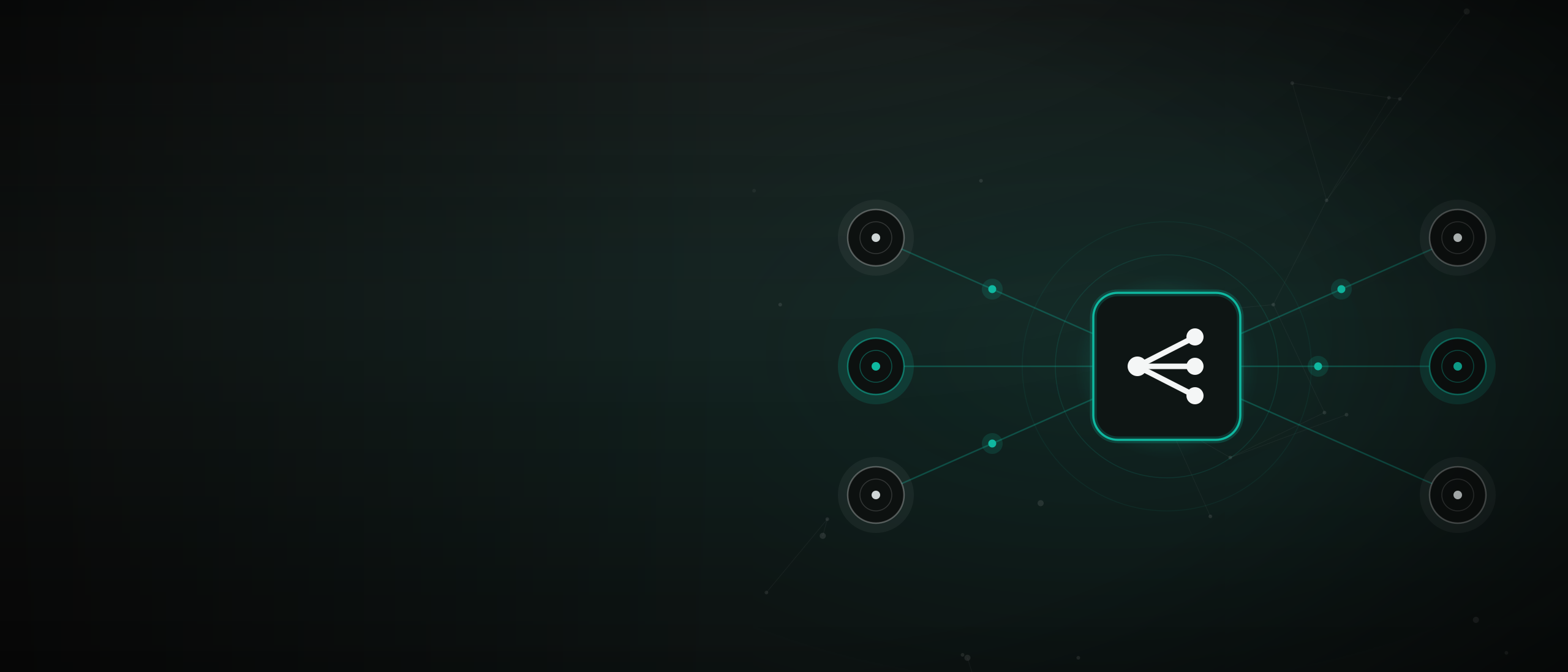
Multi-protocol agent routing is how Tragentics lets one registered agent speak A2A, MCP, OpenAI Responses, ANP, and ACP at once — each protocol routed to its own encrypted endpoint, carrying its own credential, under its own rate limit, all behind a single identity. One registration, every protocol your callers might use, each one sealed as it routes.
One agent, every protocol — each on its own encrypted endpoint
Register one agent on Tragentics and it speaks A2A, MCP, OpenAI Responses, ANP, and ACP at once. Each protocol routes to its own encrypted endpoint, carries its own credential, and runs under its own rate limit — all behind a single agent identity. One registration, every protocol your callers might use. Those protocol lanes ride the same authenticated relay behind Tragentics's secure AI agent orchestration.
That's multi-protocol agent routing the way it should work: not a translation layer you bolt onto an integration, but how the agent is registered in the first place. Most setups make you pick a protocol and rebuild for the next one. Tragentics gives you all of them from one identity, and seals each one as it routes.
The agent world fractured into competing protocols faster than anyone could keep up. Multi-protocol agent routing is how you stop choosing sides and just connect.
What multi-protocol agent routing means on Tragentics
Tragentics treats multi-protocol agent routing as one job: a single agent identity exposes a native endpoint for every protocol it speaks, and we route each incoming call to the right encrypted backend. There's no per-protocol gateway to stand up, no adapter to maintain — the agent is registered once, and every protocol it supports is reachable from that moment.
We do this better than the gateway you'd otherwise assemble because the security travels with the routing. Every endpoint is encrypted and validated as part of the route itself, not guarded by a separate product you bolt on around it. Routing and protection are the same operation.
The pressure behind this is protocol fragmentation, and it's intense. MCP and A2A have exploded into 10,000+ enterprise servers with 97M+ SDK downloads, and most organizations now have to support several at once, wiring translation layers between them. Native routing for every protocol is how you skip that tax entirely.
Speak A2A, MCP, OpenAI, ANP, and ACP — without translating anything
Every protocol Tragentics relays gets a native ingress, shaped like the real protocol: A2A arrives as tasks, MCP as tool calls, OpenAI as responses, ANP as calls, ACP as runs. A caller speaks its own protocol, and we route it to your agent — no SDK on their side, no adapter on yours. DID rounds out the set as the identity standard, not a transport.
Here's why that beats a translation gateway. Callers never have to adapt to us; we meet each one in the protocol it already speaks. Your agent registers the protocols it supports, and a request in any of them lands cleanly.
The agent ecosystem split along clear lines — MCP for tools and data, A2A for agent-to-agent collaboration — and supporting both by hand is a standing translation tax. To connect MCP and A2A agents under one roof, you'd normally run two stacks; here it's one registration. The full routing model is in protocol relay and routing.
Point every protocol at a different backend
On Tragentics, one agent can point every protocol at a different backend — per-protocol agent endpoints, each configured on its own. Your MCP server can live on one host and port, your A2A server on another, your OpenAI-compatible endpoint somewhere else again, and each one falls back to your base endpoint if you leave it unset.
That's the part most gateways can't do. Per-protocol agent endpoints mean your tool layer and your agent-collaboration layer can run on entirely separate infrastructure, scaled and deployed on their own, while the outside world still sees one agent identity. The routing figures out which endpoint a call belongs to and sends it there.
Real deployments don't run every protocol from a single box — your MCP tools and your A2A logic almost never share a server. Forcing them to is the limitation per-protocol agent endpoints remove, and the reason multi-protocol agent routing has to be multi-endpoint, not just multi-protocol. You can see how a call resolves to the right one in how the proxy works.
Every endpoint encrypted, credentialed, and rate-limited on its own
Every protocol endpoint on Tragentics is sealed on its own. Each one is encrypted at rest with AES-256-GCM, masked so the caller never sees the real address, and SSRF-validated before any call goes out — HTTPS-only, private and internal IPs blocked, failing closed if a host can't be resolved. Each carries its own injected credential and its own rate limit, enforced per agent, per protocol.
Here's where we part ways with the gateway category. Those products lead with routing and translation; we lead with security. The protection isn't a perimeter drawn around the gateway — it's applied to each endpoint individually, so MCP and A2A on the same agent are independently encrypted, independently credentialed, and independently throttled.
This matters because MCP servers are a security disaster: 41% have no authentication at all, and command injection drives 43% of MCP CVEs. An AI agent gateway that encrypts, masks, and validates every protocol endpoint is the difference between exposing your servers and routing to them safely. The credential model is in AI agent credential management, and the content-blind routing in secure agent-to-agent routing.
Discover, route, and contain — across the whole protocol mesh
Tragentics routes across the whole protocol mesh and keeps it contained. External callers reach your agent through the protocol-native URL; your own authenticated services target a protocol with the X-Tragentics-Protocol header. Responses advertise which protocols an agent speaks, so a caller arriving on one can discover the others. External invocation is owner-gated, traffic streams content-blind, and every call is recorded as metadata only.
The reason this holds at scale is that there's no weaker lane. Multi-protocol agent routing applies the same encryption, validation, and rate limiting to every protocol and every topology — agent-to-agent, pools, broadcast, scheduled — so the guarantee at five agents is the guarantee at five thousand. Adding a protocol doesn't add a soft spot.
Fragmentation is where control dies — the one tool or lane without protection is the way in. One secure multi-protocol layer beats a dozen half-secure integrations stitched together, and it's the connective tissue your zero-trust posture depends on. Connect MCP and A2A agents — and everything else — through a single model that doesn't fray as you grow.
One identity. Every protocol. Nothing exposed.
Register once, and your agent is reachable on every protocol that matters — each endpoint encrypted, masked, and rate-limited on its own, behind a single identity. You stop betting on one protocol winning and build for the mesh that actually exists.
That's what multi-protocol agent routing is for: not making you choose A2A or MCP, not making you stitch translation layers between them, but routing them all securely from one agent. Everyone else hands you a protocol and a problem. Tragentics hands you every protocol, sealed — the AI agent gateway that leads with security instead of bolting it on last. Protocol routing is the transport corner of AI agent security — every dialect on its own sealed lane.
Frequently asked questions
Can one AI agent use MCP and A2A at the same time?
Yes. On Tragentics, one registered agent exposes a native endpoint for every protocol it speaks — A2A, MCP, OpenAI Responses, ANP, and ACP — at once. A caller arrives in its own protocol and Tragentics routes it to your agent, with no separate registration or gateway to stand up per protocol.
Do callers need an SDK or adapter to reach my agent?
No. Each protocol has a native ingress shaped like the real thing — A2A as tasks, MCP as tool calls, OpenAI as responses — so a caller speaks the protocol it already uses and Tragentics routes it. Nothing to install on their side, and no translation layer to maintain on yours.
Can each protocol point to a different backend server?
Yes. Per-protocol endpoints let your MCP server, your A2A server, and your OpenAI-compatible endpoint live on entirely separate infrastructure, each configured on its own. Any protocol you leave unset falls back to the agent's base endpoint. The outside world still sees one agent identity.
How does Tragentics know which protocol a call is using?
External callers reach the agent through the protocol-native URL; your own authenticated services set the X-Tragentics-Protocol header to pick a lane. Tragentics resolves the call to the matching encrypted endpoint, and if no protocol-specific endpoint is configured, it routes to the agent's default.
Does Tragentics translate between agent protocols?
No — deliberately. Tragentics routes each protocol natively to its own endpoint rather than converting one dialect into another. Agents speak their protocol; Tragentics relays it byte for byte, content-blind. There's no lossy translation step and no shared parser to become a single point of failure.
Is each protocol on one agent secured separately?
Yes. Every protocol endpoint is independently encrypted at rest with AES-256-GCM, masked from the caller, SSRF-validated, and given its own injected credential and rate limit. MCP and A2A on the same agent are sealed and throttled on their own, so no protocol becomes a weaker lane into the others.