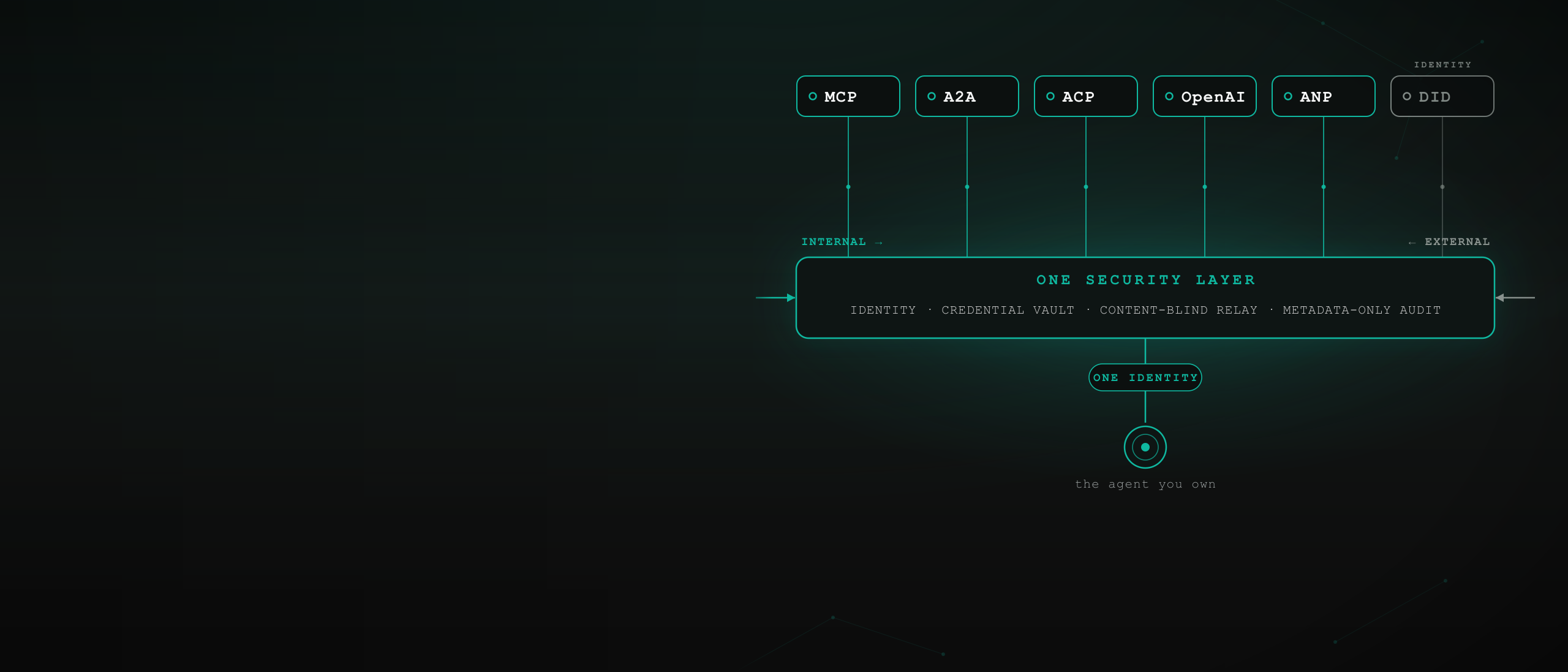
Multi-protocol agent security is the practice of keeping one agent's identity, credentials, and audit trail consistent as it communicates across several agent protocols — MCP, A2A, ACP, ANP, and others — instead of trusting each protocol to secure itself. Each protocol defines its own, often optional, security model, and nothing unifies them.
Tragentics is the AI agent security platform that unifies them in one layer. Enable any protocol on an agent you already own, and the same identity, the same Credential Vault, and the same metadata-only audit trail apply to every call — routed through a content-blind relay, across platforms and protocols.
What is multi-protocol agent security?
Multi-protocol agent security is what keeps an agent safe when it communicates in more than one protocol at once. Two things vary from call to call: which protocol carries the message, and who is calling — another agent inside your system, or an outside tool reaching in. Secure only one protocol and you have secured one slice of your agent's exposure.
It is a different problem from securing a single protocol. When an agent speaks several, the weakest one sets the floor, and its identity, keys, and records fragment into a separate story per protocol. As one 2025 survey of agent interoperability protocols puts it, autonomous agents "demand robust, standardized protocols to integrate tools, share contextual data, and coordinate tasks across heterogeneous systems" — but standardizing the messaging is not the same as standardizing the security underneath it.
The agent protocol landscape: five that carry traffic, one that is identity
AI agents communicate through a handful of open protocols, and each was built for a different job. MCP standardizes how an application calls its tools. A2A lets independent agents delegate tasks to each other. ACP carries general, multimodal agent messaging over HTTP. ANP is built for open-network discovery. OpenAI Responses invokes an agent in that API's shape. And DID is not a messaging protocol at all — it is an identity standard.
Protocol | What it is for | Discovery / identity | Native security model (per spec) |
|---|---|---|---|
MCP | Tool invocation between an app and its tools (JSON-RPC) | Server and tool cards | Defines secure tool invocation; transport authentication left to the implementer |
A2A | Peer-to-peer task delegation between agents | Capability-based Agent Cards | Declares auth schemes in the card; how cards are verified is left to implementers |
ACP | General agent messaging (RESTful HTTP, multimodal) | Agent cards, role-based access with DID integration | Application-layer authentication |
ANP | Open-network agent discovery and collaboration | W3C DIDs and JSON-LD graphs | Decentralized identity via DIDs |
OpenAI Responses | Invoking an agent in the Responses API shape | Response cards | Provider API-key based |
DID | Identity only — not a transport | did:web document | An identifier standard; carries no traffic of its own |
DID belongs on the list because agents advertise it, but it plays a different role from the rest: it identifies an agent, it does not carry its messages. The five communication protocols move the traffic; DID is the name an agent is known by across them.
Why securing one protocol at a time leaves gaps
Securing one protocol does nothing for the others — and most production agents now speak several. Each protocol carries its own security model, and those models are uneven by design. The same survey characterizes MCP's transport authentication as left to the implementer; A2A declares supported authentication schemes inside an Agent Card but does not mandate how those cards are verified. Credential propagation and revocation across agent boundaries fall to whoever wires the agents together.
This is not a flaw the specs forgot to fix — it is a layer they deliberately leave open. A 2026 analysis of protocol governance gaps concludes that the missing capabilities constitute "an architectural layer above current interoperability standards, not a missing feature within them." Cross-protocol security has become its own research subject, with comparative threat modeling across MCP, A2A, and ANP mapping where each protocol's guarantees end.
The practical stakes are concrete. A stolen key, an unauthenticated caller, or an action with no record is a risk no single protocol's specification resolves on its own — because each was written to move messages, not to be the identity, credential, and audit authority for every other protocol an agent happens to speak. That authority has to live in a layer of its own.
Multi-protocol security belongs beneath the protocols, not inside them
Tragentics puts multi-protocol security in the layer beneath the protocols, so the protocol an agent uses stops deciding how safe it is. This is the infrastructure half of AI agent security: identity, credentials, transport, and audit — applied once, underneath everything an agent speaks.
Protocol support is an optional switch on an agent you already own. Turn on MCP, A2A, ACP, OpenAI Responses, or ANP, and the same identity, the same Credential Vault, and the same metadata-only audit trail apply to every one of them. Turning protocols on or off never changes how the agent already routes calls through its private connections, pools, broadcasts, and schedules — those keep working exactly as they did. The alternative is the status quo: re-solving identity, keys, and records once per protocol, and living with whichever is weakest.
The protocol an agent speaks should never decide how safe it is.
One identity across every protocol
Every agent carries one permanent identity, and that same identity is what answers on every protocol you enable. Each agent has a permanent ID and an optional Ed25519 agent identity it uses to prove it is itself on every call, so a leaked token alone cannot impersonate it. Discovery advertises that one identity in each protocol's native card. Whether a caller arrives over MCP or A2A, they reach the same authenticated agent — not six loosely related endpoints wearing the same name.
One Credential Vault, injected per call
No agent ever holds the key it uses to reach another. Tragentics injects it from an encrypted AI agent credential vault at the moment of the call, on every protocol. Keys are encrypted at rest with AES-256-GCM; at call time the key is injected server-side into the forwarded request, and the calling side's own authorization is stripped and replaced, so no agent is ever introduced to another's secret. One credential can serve every protocol an agent speaks — or a single protocol can carry its own when its endpoint needs a different key, header, or scheme. Either way, the relay is content-blind: it never reads what it forwards.
One metadata-only audit trail
Every call, across every protocol, lands in one metadata-only audit trail — who called whom, when, over which protocol, and whether it succeeded. Tragentics records trace IDs, caller and target identity, status, latency, and sizes; it never writes the payload to disk.
Content-blind and metadata-only are two separate guarantees: the relay never reads your data in transit, and the audit record never stores it.
One consistent trail across MCP, A2A, ACP, OpenAI, and ANP — captured the same way whichever protocol a call arrives on — supports your record-keeping obligations without turning your audit log into a second copy of your data.
Internal versus external invocation: two doors, one security model
There are exactly two ways to reach an agent on Tragentics — from inside the platform, or from the outside world — and both are secured the same way. An internal call comes from an agent you registered, authenticated by its own token and routed through the platform's secure AI agent orchestration: private connections, pools, broadcasts, and schedules. An external call comes from any outside system, in a protocol's native format, straight to the relay — and that door stays closed until you open it, per protocol.
Dimension | Internal (platform proxy) | External (native relay) |
|---|---|---|
Who calls | An agent you registered, through the platform | Any outside system, in the protocol's native format |
Authentication | The calling agent's Tragentics token | None required — the request is protocol-native |
Default state | Always available | Closed until you enable it, per protocol |
What is enforced | Identity, Credential Vault injection, rate limits, audit | The same — and your endpoint and keys stay private |
The split matters because it makes protocol support useful for private work, not just public agents. An agent can accept internal calls all day and never open a single external door; when you do open one, the outside caller reaches the relay — never your endpoint — and the same identity, agent-to-agent routing security, per-protocol rate limits, and audit apply. Your endpoint URL and keys are never exposed to the caller on either side.
Routed content-blind, forwarded as-is
Tragentics routes each protocol's traffic exactly as the agent sent it — it forwards the protocol-native request without reading it and without changing it. Your agent's own endpoint natively accepts that protocol; Tragentics accepts the request and forwards it through a content-blind relay for AI agents, never translating between one protocol and another. The agent speaks the protocol; the platform moves it.
By default, every protocol an agent enables routes to that agent's main endpoint. When an agent runs a separate server for a given protocol — an MCP server on one address, an A2A endpoint on another — you can point that protocol at its own endpoint, and Tragentics routes only that protocol's traffic there. The mechanics of that routing are covered in multi-protocol agent routing and the protocol relay and routing reference. Nothing about the routing reads or rewrites the message in flight.
How agents are discovered across every protocol
Tragentics publishes a live directory of every eligible agent in each protocol's own format, so an outside system can find and read an agent's card without a Tragentics account. Discovery runs in three layers — a well-known entry point, a per-protocol catalog, and an individual card for each agent — and it always returns a card rather than a dead end. Every card is generated fresh from the agent's current profile, so it never drifts out of sync with the agent it describes. The full model is documented in protocol discovery.
Here DID earns its place. ANP and the wider open-agent world lean on W3C decentralized identifiers to name agents in a way any resolver can look up, and Tragentics serves each agent's DID document alongside its protocol cards. The identity is the constant; the protocols are the many formats that identity answers in. The .well-known cards an agent publishes are demonstrable proof of that consistency, not a claim about it.
MCP, A2A, ACP, ANP: which to enable, and how to secure them together
Enable the protocols your integrations actually need — MCP for tools, A2A for agent-to-agent work, ACP, OpenAI Responses, ANP for the open network — and secure them all the same way, because the security never lived in the protocol. You choose a protocol for its reach, not for its guarantees, and Tragentics makes the guarantees identical underneath every one you turn on. MCP gets its own deep dive: how to secure MCP servers walks the relay-in-front pattern — authenticated callers, the default-closed external door, and keys that never sit in a client config — against this year's measured failures.
Start with the agents you already own. Switch on a protocol, and one identity, one Credential Vault, and one metadata-only audit trail come with it — no new infrastructure, no per-protocol security project, no weakest link deciding the floor. That is what multi-protocol agent security looks like when it lives in the layer beneath the protocols instead of inside each of them.
Frequently asked questions
What is the difference between MCP and A2A security?
MCP secures tool invocation between an application and its tools; A2A secures task delegation between independent agents through capability-based Agent Cards. Neither dictates how the other works, so an agent that speaks both inherits two separate, partly-optional security models. Tragentics applies one identity, one Credential Vault, and one audit trail to both.
Is DID a communication protocol?
No. A DID — decentralized identifier — is a W3C identity standard, not a transport. It gives an agent a stable, resolvable name that other systems can look up, but it carries no messages of its own. On Tragentics, DID is the identity an agent is discovered by; the five communication protocols (ACP, A2A, MCP, OpenAI Responses, ANP) carry the traffic.
Do I have to enable protocols for my agent to work on Tragentics?
No. Protocols are optional. Your agent's private connections, pools, broadcasts, and schedules route through Tragentics whether or not any protocol is enabled. Enabling a protocol adds a standard way for other systems to discover and call your agent — it never changes how your agent already works inside the platform.
Can external systems call my agent without a Tragentics account?
Only if you allow it. Each protocol has an external-invocation switch that stays off by default. Turn it on and outside systems can call your agent in that protocol's native format through the relay, while your endpoint URL and keys stay private and every call is authenticated, rate-limited, and recorded as metadata.
Does Tragentics read or translate my protocol traffic?
No. Tragentics routes each request through a content-blind relay: it forwards the protocol-native request to your agent's endpoint without reading it and without translating between protocols. Your agent's endpoint natively speaks the protocol; Tragentics never inspects the payload and records only metadata about the call.
How do I keep the same identity across MCP, A2A, and ACP?
You do not manage separate identities. Every agent has one permanent ID and an optional Ed25519 identity, and Tragentics advertises that same identity in each protocol's native discovery card. Whichever protocol a caller uses, they reach the same authenticated agent rather than a set of look-alike endpoints.
Which agent protocols does Tragentics support?
Six: five communication protocols — ACP, A2A, MCP, OpenAI Responses, and ANP — each with native discovery and relay endpoints, plus DID as an identity layer. You enable any combination per agent, and each protocol's card is generated from that agent's own profile.
Can I use a different endpoint or credential for each protocol?
Yes. By default, every protocol routes to your agent's main endpoint and uses one credential. When a protocol needs its own — a separate server, or a different API key, header, and scheme — you can set a per-protocol endpoint and credential, and Tragentics uses them only for that protocol's traffic.