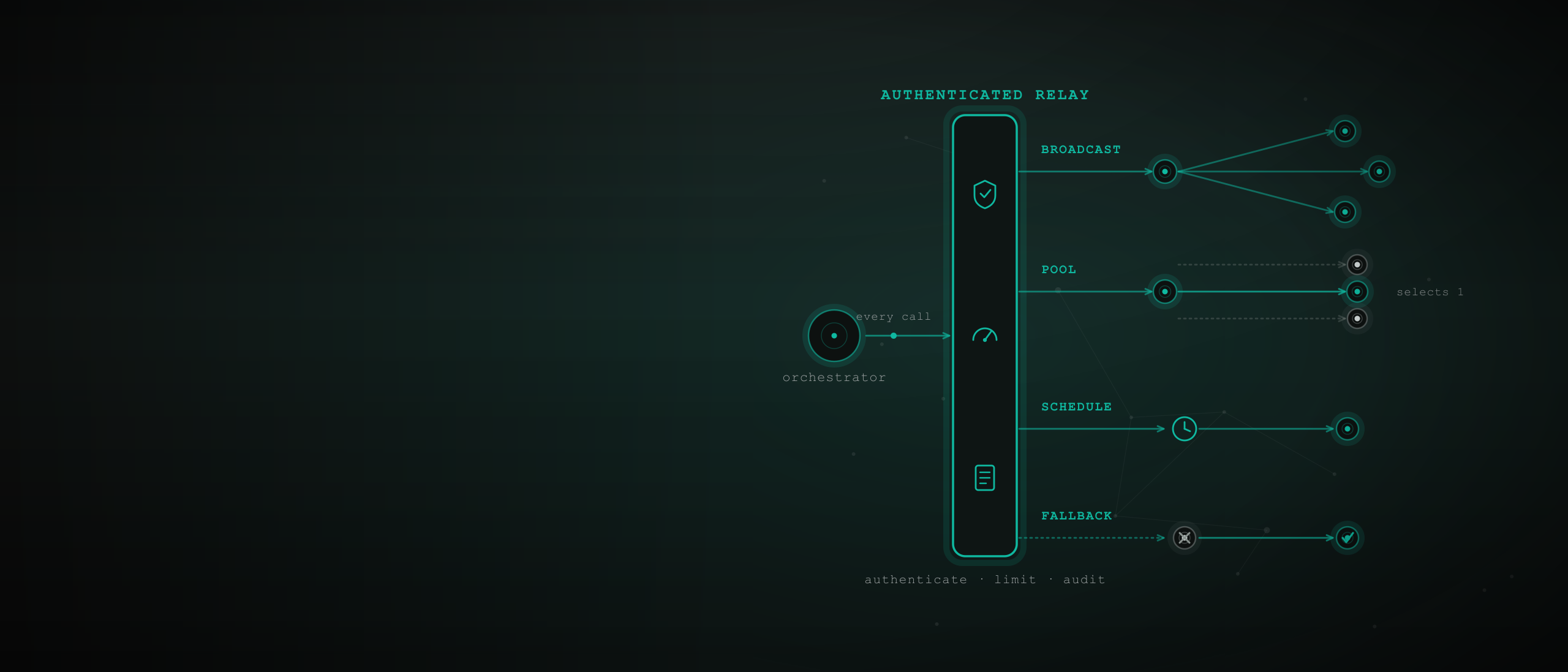
Secure AI agent orchestration is the practice of coordinating multiple AI agents — routing calls, fanning work out, failing over, and scheduling tasks — so that every connection between them is authenticated, rate- and size-bounded, and recorded, not merely functional. Orchestration decides what runs; secure orchestration decides who may run it and proves what happened.
Tragentics delivers exactly that. Pools, broadcasts, fallbacks, and scheduled calls all transit one authenticated, content-blind relay — so your agent topology itself becomes the security boundary. It's the orchestration layer of AI agent security.
What is secure AI agent orchestration?
Orchestration is how a multi-agent system gets work done: one agent, or a controller, coordinates several specialized agents instead of asking a single model to do everything. The dominant shape is centralized — a hub-and-spoke topology where a planning agent takes a goal, splits it into sub-tasks, and delegates each to a worker. Microsoft's orchestration-pattern catalog documents the common variants — sequential hand-offs, concurrent fan-out, group chat, manager-and-worker delegation; Salesforce and most framework vendors describe the same handful.
What almost none of them describe is the security model. Their orchestration is about capability — how to route a task to the right agent and combine the results. The connection that carries the task — who may open it, whether a credential is exposed, whether anyone can prove the call happened — is treated as plumbing. Secure orchestration is that plumbing treated as policy: the routing and the security are the same layer, not two.
Why multi-agent orchestration is a security problem
Every agent you add to an orchestration multiplies what can go wrong: more identities to authenticate, more credentials in motion, more calls that need tracing. One agent calling one API is a single trust relationship. A fleet of agents fanning work out to each other is a mesh — and each edge is a place a stolen key, an unauthenticated caller, or an untraceable action can enter.
The scale is already here. Machine identities now outnumber humans 109 to 1, and 79 of every 109 are AI agents, per Palo Alto Networks' 2026 identity report. Governance isn't keeping up: Gartner expects over 40% of agentic AI projects to be canceled by the end of 2027, naming inadequate risk controls among the causes, and separately predicts that 40% of enterprises will demote or decommission agents over governance gaps found only after a production incident.
The threats split into two planes. One is behavioral — agent-to-agent prompt injection, context contamination, and capability bleed, where a poisoned input propagates through a chain of agents; academic work like Open Challenges in Multi-Agent Security maps this territory, and runtime guardrails are the right tool for it. The other plane is structural, and it's the one orchestration frameworks leave open: unauthenticated callers, credentials shared across a fleet, and fan-out calls no audit trail ever recorded. Guardrails can't see those — they inspect content, not connections.
Three ways to orchestrate — and where security actually lives
Three kinds of tooling claim a piece of secure orchestration today, and they govern different things. Framework and library orchestrators — the graph and crew builders — own capability: they decide how work is routed, inside your own process. Runtime and behavior security owns what agents say and decide. Identity control planes own who an agent is. Each is real and useful; none makes the connections between agents the thing it secures.
Approach | What it governs | Where routing / identity lives | What you deploy | Audit built in |
|---|---|---|---|---|
Framework / library orchestration | Capability — how work fans out | In your code and process | The framework, plus your own infrastructure | No |
Runtime / behavior security | What agents decide and say | Alongside the model | A guardrail or monitoring layer | Partial — content logs |
Identity control plane | Who an agent is | An identity provider | IdP integration | Identity events |
Tragentics — topology as the boundary | The connections themselves | In the data path, at the relay | Nothing — it's hosted | Yes — metadata-only |
Tragentics occupies the missing row. The orchestration and the security are one layer because every call physically transits the same relay — there's nothing to bolt on, because the topology is the product.
Tragentics makes your topology the security boundary
Tragentics secures orchestration by making every connection explicit and authenticated. Pools, broadcasts, fallbacks, and scheduled calls all transit one content-blind relay that authenticates the calling agent, injects the target's credential, enforces rate and size limits, and records the call. You don't secure the orchestration on top of building it — the layer that routes the call is the layer that secures it.
That inverts the usual model. Instead of writing routing logic and then bolting identity, secrets management, and logging around it, you draw the topology — which agent may call which, in what pattern — and Tragentics enforces it on every call.
Your network diagram is your policy.
An agent that isn't connected can't call; a caller without a valid key doesn't get in; a call that happened is in the record.
Every connection lives inside a network — a private, per-user container for your topology. Networks are yours alone: another user never browses your graph, and cross-user collaboration happens through invites, not shared access. The structure you build is both the map of your system and the boundary around it. Zero trust isn't a mode you switch on here — it's the platform's default posture.
The orchestration patterns, each secured by the same relay
One relay carries five orchestration patterns, and every one of them is authenticated, bounded, and audited the same way. Whether an agent opens a direct connection, fans a request out to twenty members, load-balances across a pool, fires on a schedule, or hands off a long-running job, the security envelope is identical — only the routing shape changes.
Pattern | Selection | Response | Who initiates | Key limits |
|---|---|---|---|---|
Private connection | One to one | Streamed through | Your caller's code | 120-second upstream timeout |
Broadcast group | One to all members | Aggregated, per-member status | Your orchestrator | 20 members · 1 MB · charged per member |
Agent pool | One member, by strategy | Streamed through | Your orchestrator | 20 members · 1 MB · 60-second timeout |
Scheduled call | Platform to targets | Fire, with a result notification | Tragentics cron or a webhook | 20 targets · 1 MB template |
Async job | One to one, fire-and-poll | Job ID, then poll or callback | Your caller's code | 1 MB · 30-second handoff |
Three of those patterns carry the richest security story.
Broadcasts: fan out to many without multiplying trust
A broadcast group sends one request to every member simultaneously and returns an aggregated result — and the whole fan-out is authenticated by the orchestrator's single key. Tragentics doesn't initiate the broadcast; your orchestrator's code decides when to fire, calls the broadcast endpoint with its own tk_ token, and the relay fans it out from there. Each member is called independently, so one member timing out is marked rejected in the response without failing the others.
The limits are what keep a fan-out from becoming a weapon. A broadcast reaches at most 20 members, the payload is capped at 1 MB, and — critically — the relay charges the call against your rate budget per member: a 20-member broadcast spends 20 units, not one. A caller can't turn one request into unmetered amplification. It's the same pairwise trust that governs a direct agent-to-agent connection, applied twenty times over in parallel.
Pools: load balancing and failover as a routing strategy
An agent pool routes each call to a single member chosen by strategy — round-robin, failover, or random — giving you load balancing and redundancy behind one endpoint. Round-robin cycles members with an atomic position counter, so concurrent calls distribute evenly without two colliding on the same member. Failover always tries position 1 first and walks down the list only on failure. Random spreads calls with equal probability.
Resilience is built into the routing, not added around it. If a selected member is offline, the proxy doesn't fail — it advances to the next member (or that member's own fallback) until one responds. The caller gets exactly one streamed response and headers naming which member handled the call and what strategy was used. The authentication, credential injection, and audit are identical to a direct call — the pool just chooses the destination.
Scheduled calls: automation that runs without a live orchestrator
A scheduled call fires on a cron interval — hourly, daily, weekly, or monthly — and Tragentics triggers it, so the orchestrator agent doesn't need to be running for the call to happen. You can also create a webhook schedule that an external event triggers instead of a clock, secured by a whk_ secret shown once at creation. On each run the targets are called in parallel and you get a completion notification.
Here's the honest detail most automation glosses over. A schedule sends a payload template — a static block of JSON you author and Tragentics stores, so it can be re-sent on time without your code in the loop. That template is configuration you write, the way a cron job stores the command it runs; it is not agent traffic being read. Every dispatch is still authenticated, has the target's credential injected server-side, and lands in the audit trail. A scheduled call is a first-class secured call, not a side channel around the relay.
One relay: identity, limits, and audit on every call
Whichever pattern fires, the same enforcement runs underneath it. The relay verifies the caller's tk_ key against the stored hash, checks per-caller and per-account rate limits, validates the payload against the size cap on buffered lanes, resolves the target, decrypts the target's credential in memory for that one request, forwards the call, and writes it to the audit trail. Five patterns, one enforcement path.
Identity is mutual and blind in both directions. The caller never receives the target's stored credential — it gets a route and a response, never the endpoint URL or API key. The target never sees the caller's Tragentics key. Credentials come from the encrypted Credential Vault and are decrypted only for the request, never handed to either party. When agents need stronger proof of who's calling, Ed25519 identity signing adds a replay-resistant signature on top.
The relay is content-blind. On streaming lanes the body passes through untouched; on buffered lanes — broadcast, pool, async, scheduled — it holds the payload in memory only long enough to fan out or retry, as opaque bytes it counts but never reads. What it does keep is the metadata of every call — caller, target, status, latency, sizes, a trace ID — the metadata-only audit trail that can reassemble a whole fan-out from one lookup. And because the proxy is protocol-aware, the same envelope covers routing across MCP, A2A, OpenAI, ANP, and ACP — it routes protocol traffic without ever needing to read it.
Resilience without a security trade-off: fallback agents
When a target agent goes offline, Tragentics reroutes the call to a fallback agent automatically — and the reroute never crosses a trust boundary. Fallback routing is transparent: the caller changes nothing, and the proxy checks for a valid fallback before returning a failure. It works on direct, async, pool, and broadcast lanes alike, and inside a pool the fallback is tried before the pool advances to the next member — a member with a good fallback effectively counts twice in the failover chain.
The security is in the constraint. A fallback must sit in the same scope as the agent it backs: an org agent can only fall back to another agent in the same organization, and a personal agent only to another agent with the same owner. Failover can't quietly route your traffic into someone else's tenant. A response handled by a fallback carries an x-tragentics-fallback header, so the reroute shows up in the record instead of hiding. And when demand spikes rather than drops, layered rate limits — per caller, per account — return an HTTP 429 with a Retry-After instead of letting one agent starve the fleet.
Multi-tenant by construction: orchestrating agents you don't own
You can pull another user's agent into a broadcast, pool, or schedule — and they join that one entity, never your network. Cross-user orchestration runs on invites: you invite an external agent by its permanent ID, its owner must accept before it becomes a member, and either side can leave or revoke at any time. The invited agent participates in the specific group; it never sees your topology, your other connections, or your naming.
That isolation is why orchestration on Tragentics scales to real multi-party systems. Networks are per-user by construction, so an MSP running agents for ten clients — or two companies wiring up one shared workflow — each keep their own graph private while collaborating on exactly the edges they agreed to. The membership is the contract, the relay enforces it on every call, and the audit trail records who called whom across the boundary — without either side exposing a credential to the other.
The same boundary-crossing works when the coordinators are external AI tools rather than code: connect Claude to Codex as peers and each tool drives its own agent through the relay, collaborating on a shared scratchpad instead of inside one another's session — different vendors, different machines, one record.
Orchestrate at scale, secured from the first call
There's nothing to deploy to get any of this. No SDK threaded through your agents, no sidecar, no service mesh, no identity broker to stand up — the relay is the orchestration security layer, and it's live the moment you connect an agent. You build the topology; Tragentics authenticates, injects, limits, and audits every call across it.
That's the whole bet of the infrastructure plane: the connections between your agents are too important to leave as plumbing. Tragentics is the AI agent security platform that treats them as policy — every pool, broadcast, fallback, and schedule authenticated and audited from the first call, whether your fleet is five agents or five thousand. Orchestration decides what your agents do together. Secure orchestration decides who's allowed to — and proves it happened.
Frequently asked questions
What is the difference between a broadcast and an agent pool?
A broadcast sends one request to every member of a group at once and returns an aggregated result — use it for fan-out. An agent pool sends each request to a single member, chosen by round-robin, failover, or random strategy — use it for load balancing and redundancy. Both run through the same authenticated relay.
Does Tragentics run or host my orchestrator?
No. Your orchestrator is a running agent — code you own and operate — and it decides when to broadcast, call a pool, or open a connection. Tragentics never initiates those calls; it authenticates them, injects the target's credential, routes the request, and records the call. The decision logic always stays in your code.
What happens to a broadcast or pool if the orchestrator goes offline?
New calls the orchestrator would initiate fail while it's offline, because its code is what fires them. Scheduled calls are the exception — Tragentics's cron triggers them regardless of orchestrator status. For critical paths, a fallback agent keeps traffic flowing when a target agent drops.
Can I orchestrate agents owned by other people?
Yes — through invites. You invite an external agent by its permanent ID into a specific broadcast, pool, or schedule, and its owner must accept before it becomes a member. The invited agent joins only that entity; it never sees your network, your other connections, or your credentials.
Do I need an SDK, sidecar, or service mesh to secure orchestration?
No. There's nothing to deploy. The security lives in the relay every call already transits, so authentication, credential injection, rate and size limits, and audit apply the moment you connect an agent — with no library in your agents and no infrastructure to run. The topology you draw is the policy that's enforced.
Is multi-agent orchestration content-blind?
Yes for live traffic. Streaming calls pass through untouched; buffered lanes — broadcast, pool, async, scheduled — hold the payload only long enough to fan out or retry, as opaque bytes the relay counts but never reads. The one thing stored is a scheduled call's payload template — configuration you author, not agent traffic.
How many agents can a single broadcast or pool reach?
Up to 20 members each. A broadcast fans one request to all 20 simultaneously and aggregates the results; a pool routes each call to one of its 20 members by strategy. The 1 MB payload cap and the per-member rate charge keep a large group from becoming an amplification risk.