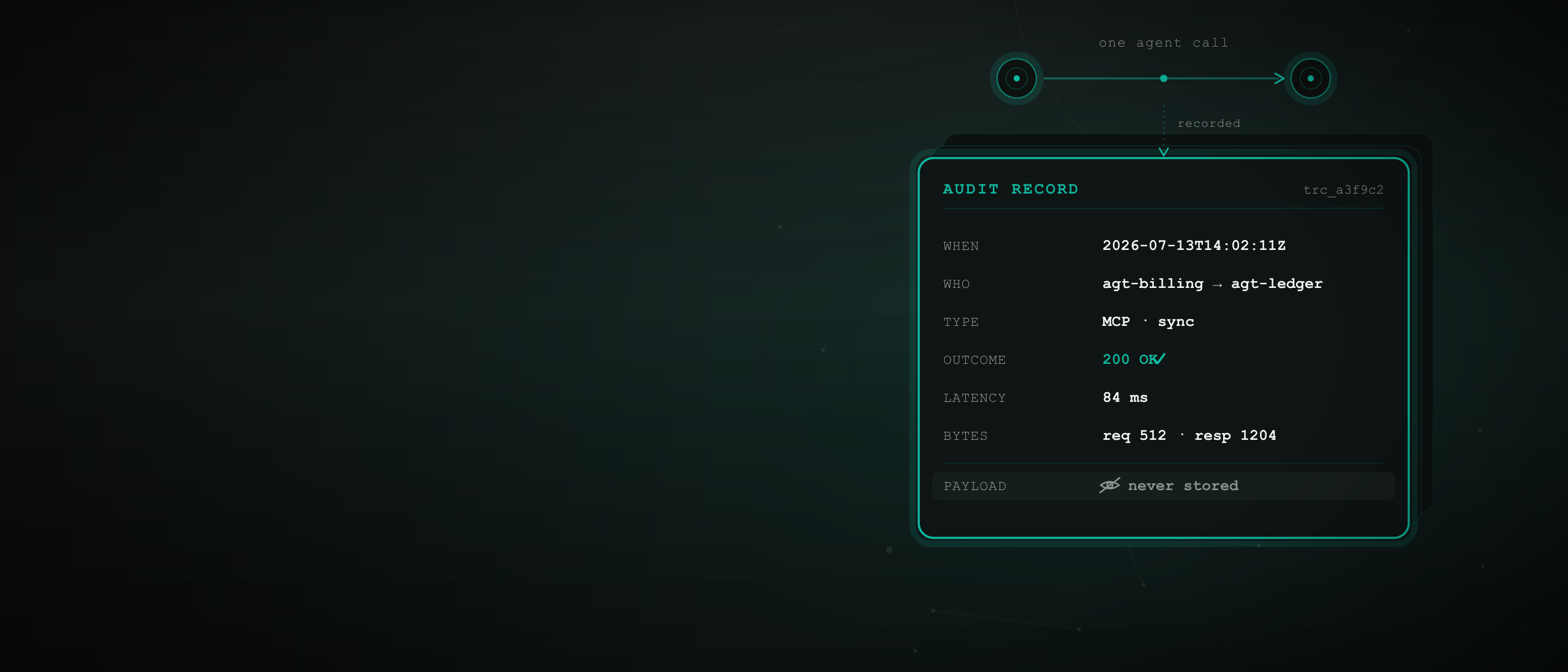
An AI agent audit trail is a durable, tamper-evident record of what your AI agents did — every call and privileged action, showing who acted, when, on whose authority, and with what outcome. It exists to make an agent's activity reconstructable and provable after the fact, for debugging, incident response, and compliance.
Tragentics is the AI agent security platform that records a metadata-only audit trail: every call it routes is written to a durable record automatically, while the payload streams through content-blind and is never stored. The trail is complete about the call; your data isn't in it.
What is an AI agent audit trail?
An AI agent audit trail is a structured, tamper-evident record of every action an autonomous agent takes — built for forensic reconstruction and compliance evidence, not casual debugging. Where an application log is a stream of developer messages, an audit trail is the authoritative account of who did what, when, on whose authority, and with what result, kept so it can be trusted later.
The field is converging on this quickly. Industry references define an agent audit trail as a complete record connecting every automated action to the identity, authority, tools, and outcome behind it (MightyBot, Collibra), and there is now an IETF draft standard for a common agent-audit-trail logging format. The shared premise: an agent is otherwise a privileged actor with no accountability, so every significant action must leave a record.
What must an AI agent audit trail capture?
An AI agent audit trail must capture enough to answer, for any past action: which agent did it, what kind of action it was, when, on whose authority, and with what outcome — plus, for high-assurance use, the inputs and decisions behind it. The consensus checklist spans agent identity and version, the trigger, every tool and system call, the outcome, and timing (ARMO's minimum-viable audit trail, Maxim).
Not all of it is the same kind of data, and that difference decides where each piece can safely live. The who, what-kind, when, on-whose-authority, and outcome are metadata — facts about the call that never require reading its contents. The inputs, outputs, and decision logic are content — the payload itself. The table splits the checklist that way, because the two halves belong in different places.
What to capture | Why it matters | Metadata or content? | Where it can live |
|---|---|---|---|
When — timestamp + trace ID | Order events; correlate a fan-out | Metadata | The routing layer's record |
Who — agent identity + owning account | Tie every action to an owner | Metadata | The routing layer's record |
What kind — call type + source | Classify the action | Metadata | The routing layer's record |
Tool & system calls invoked | Know which tools an agent reached | Metadata | The routing layer's record |
Outcome — status, error, timeout | Prove success or failure | Metadata | The routing layer's record |
Duration + volume (byte counts) | Performance, size, anomalies | Metadata | The routing layer's record |
Authorization decisions | Prove who was allowed to do what | Metadata | The routing layer's record |
Inputs, outputs & decision logic | Trace why an output happened | Content | Your agent endpoint |
Audit trail vs. audit log vs. observability
The three terms overlap but aren't interchangeable. An audit log is the set of immutable, timestamped entries. An audit trail is the reconstructable story those entries let you assemble — who did what, when, in what order. Observability is the operational view — health, latency, success rates — you watch in real time. Audit is about proving what happened; observability is about seeing how it's going.
In practice you want all three from the same record, because splitting them is where homegrown logging fails: a pile of disconnected log lines with no correlation ID is neither an audit trail nor observability — just noise. The operational-monitoring half is covered in depth in AI agent observability; this guide is about the audit trail that proves what happened.
Why logging payloads turns your audit trail into a liability
Capturing the payload — the prompts, responses, and retrieved data most audit guidance tells you to log — turns your audit trail into a second copy of your most sensitive data, one you now have to secure, minimize, defend, and disclose. The record meant to protect you becomes the thing most worth attacking.
The exposure is quantifiable. IBM's 2025 report puts the average breach at $4.44 million, and every prompt copied into a log widens that surface. Retention cuts against you in litigation, too: a US federal court ordered OpenAI to preserve consumer chat logs — including conversations users had deleted — for discovery. And it runs against the direction of regulation: GDPR's data-minimisation principle asks every system to hold only the data it needs.
Payloads you store can be breached and compelled; payloads you never stored cannot.
Can an audit trail be complete without storing the content?
Yes — and it's the position Tragentics is built on. Who called whom, when, on whose authority, and with what outcome are all metadata facts; none of them requires reading the message. Tragentics records a metadata-only audit trail for every call it routes, while the request and response stream through a content-blind relay and are never written to disk.
That completeness-without-content resolves the paradox at the center of audit tooling: one rule says keep a record of everything, another says hold as little data as possible. A metadata-only trail obeys both — complete about the call, empty of the content. The full how-to is in auditing AI agents without storing the payload.
What a metadata-only audit record contains
Every call Tragentics routes writes the facts an audit actually needs — and never the bodies. The record captures when the call happened plus a trace ID, who called whom, what kind of call it was, the outcome, the latency, and the request and response sizes in bytes — alongside authorization decisions and agent lifecycle events in the same owner-scoped trail.
Field | What it records |
|---|---|
When | Timestamp + a trace ID correlating every leg of a fan-out under one top-level request |
Who | Caller + target agent (permanent IDs), owning accounts, organization context |
What kind | Call type (sync / async / broadcast / pool / scheduled / relay) + connection source |
Outcome | Success / error / timeout / rejected + upstream HTTP status + error category |
Duration | End-to-end latency in milliseconds |
Volume | Request + response sizes in bytes — never the content |
Authorization | Every denied request and every privileged action, with the reason |
Lifecycle | Agent status transitions, credential rotation, revocations |
None of these fields required reading a prompt. The record is assembled entirely from the transport envelope — the same surface the Credential Vault and identity checks operate on — and the platform documents it field by field.
How do you reconstruct a multi-agent call?
You reconstruct a whole multi-agent interaction from a single trace ID. Tragentics stamps every call with one, and every leg of a broadcast or pool fan-out inherits the same top-level ID — so one lookup pulls the entire flow back together: which agent called which, over which protocol, whether it succeeded or fell back, and how long each hop took.
That turns an incident into a query instead of a week of forensics. The trace explorer lets you search by trace ID and filter by protocol or status — to find, say, every failed MCP call — then expand any one to see its full metadata. It's the same backbone behind AI agent observability across the fleet.
How long must AI agent audit logs be retained?
How long you must keep AI agent logs depends on your regime, but the floors are rising: the EU AI Act requires high-risk systems to retain their automatically generated logs — a six-month minimum for most sectors — and frameworks like SOC 2 tie retention to your stated controls. The through-line is that the record has to still exist when someone asks, often months or years later.
Tragentics keeps its call and authorization records automatically for at least 12 months — beyond the Act's six-month floor — and agent revocation records for seven years, with nothing for you to manage. Every record is scoped to its owner by row-level security, with no browser write path into the logs, so the trail is both retained and tamper-resistant when an auditor asks for it.
Does an AI agent audit trail make you compliant?
No — an audit trail supports compliance; it doesn't confer it, and any tool that claims otherwise is overselling. Regulations place their obligations on the provider or deployer of an AI system, and a record is one piece of the evidence those obligations call for — not a substitute for meeting them.
This matters for where Tragentics sits. Tragentics is content-blind transport infrastructure — it authenticates callers, injects credentials, and routes calls; it runs no inference and makes no decisions with your model. So under the EU AI Act, the Article 12 record-keeping duties (effective 2 August 2026) are yours as the provider or deployer, not Tragentics'. What Tragentics provides is the transport half of the record — automatic, durable, already kept — which you combine with the input and decision logs you keep at your own endpoint.
What Article 12 expects | What Tragentics provides | What remains yours |
|---|---|---|
The period of each use | Start timestamp + measured duration for every routed call | Tying a routed call back to your own input/output records |
Traceability of operation | Status, error class, and a correlation ID across multi-step calls | The decision logic and input data behind each call |
Retention | ≥12 months, automatic (revocation records, 7 years) | Retaining your own endpoint logs for your required period |
Because Tragentics is content-blind, the input-data record the Act expects for a high-risk system stays with you, at your own endpoint. The metadata trail supplements it — it does not replace it.
That split is the design, not a gap: the metadata trail supports your record-keeping and traceability obligations without ever pretending to be your compliance.
Where the audit trail fits in AI agent security
The audit trail is the accountability layer of the infrastructure plane — the evidence that proves what an agent's identity, credentials, and connections actually did. Identity says who an agent is; credentials govern what it can reach; the audit trail is the durable record of what happened, so the other guarantees can be verified after the fact rather than merely trusted.
Within AI agent security, this is the half that doesn't require reading the payload: the behavior plane logs what an agent decided and said, and must read the content to do it; the infrastructure-plane audit trail records who did what, when, and with what outcome — from the envelope alone. It's why the record can be content-blind and still complete, why it sits in one system with the Credential Vault and per-call identity, and why a zero-trust posture can prove itself without surveilling your data. Against the audit tools that log everything, that's the difference.
Frequently asked questions
What is an AI agent audit trail? An AI agent audit trail is a durable, tamper-evident record of what your agents did — every call and privileged action, showing who acted, when, on whose authority, and with what outcome. It exists to make agent activity reconstructable and provable after the fact, for debugging, incident response, and compliance.
What's the difference between an audit trail, an audit log, and observability? An audit log is the set of immutable, timestamped entries. An audit trail is the reconstructable story those entries let you assemble — who did what, when. Observability is the real-time operational view: health, latency, success rates. Audit proves what happened; observability shows how it's going. Ideally all three come from one record.
Can you audit AI agents without storing the prompts and responses? Yes. Who called whom, when, on whose authority, and with what outcome are all metadata facts that never require reading the message. A metadata-only audit trail records every call while the payload streams through content-blind and is never written to disk — complete about the call, empty of the content.
What does an AI agent audit trail need to record? At minimum: a timestamp and trace ID, the caller and target identities and their authority, the call type, the outcome (status, error, timeout), the latency, and the sizes in bytes. High-assurance use also needs the inputs, outputs, and decision logic — the content — which is kept at your own agent endpoint, not in the transport record.
How long do AI agent audit logs need to be kept? It depends on your regime, but the floors are rising — the EU AI Act sets a six-month minimum for most sectors, and frameworks like SOC 2 tie retention to your controls. Tragentics keeps call and authorization records automatically for at least 12 months, and agent revocation records for seven years.
Does using an audit trail make me EU AI Act compliant? No. An audit trail supports compliance; it doesn't confer it. The Act's Article 12 duties fall on the provider or deployer of the AI system. Tragentics is content-blind infrastructure, not the provider — it gives you the automatic transport record, which you combine with the input and decision logs you keep at your own endpoint.
How do you trace a single call across a multi-agent workflow? By trace ID. Every call carries one, and every leg of a broadcast or pool fan-out inherits the same top-level ID — so one lookup reassembles the whole flow: which agent called which, over which protocol, the outcome, and the latency per hop. A trace explorer lets you search and filter to any single call.
Is a metadata-only audit trail enough for a high-risk AI system? For the transport record — proving which calls happened, when, and with what outcome — yes. But a high-risk system under the EU AI Act also needs a record of its input data and decisions, and because a content-blind relay never sees the payload, that part stays with you at your endpoint. The metadata trail supplements your record; it doesn't replace it.