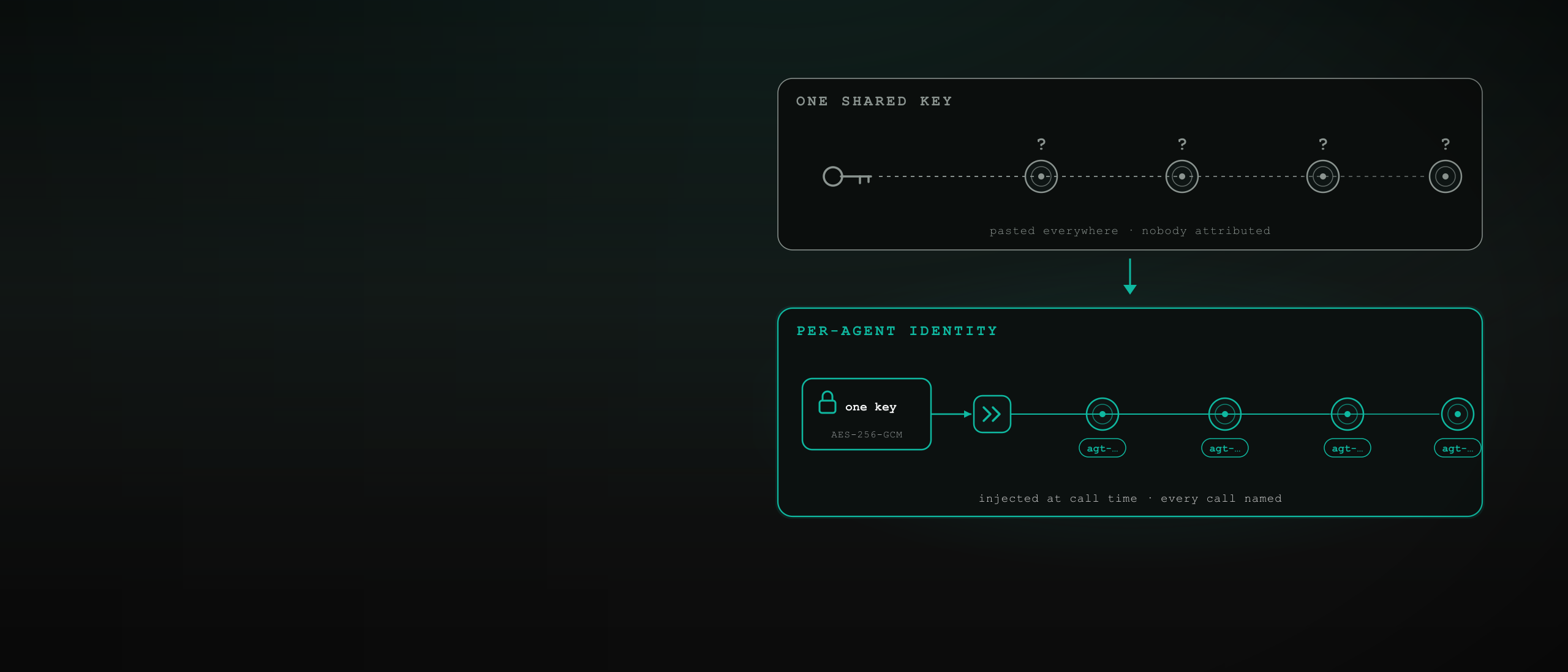
Tragentics gets your AI agents off a shared API key in three moves: register each agent so it has its own identity, store the key once in the encrypted Credential Vault, and delete it from every config. From then on, calls inject the key server-side — and every call is attributed to the specific agent that made it.
The job: one key, many agents, zero attribution
Tragentics ends the shared-key setup that most agent fleets quietly run on — one provider key pasted into every agent's config, every teammate's env file, every contractor's laptop. On Tragentics, each agent carries its own identity, the key lives encrypted in one place, and no call is anonymous.
You know the trigger moments. The API bill spikes and nobody can say which agent did it. A contractor rolls off and the key they had is the key everything has. A new agent ships, and the fastest path is pasting the same key one more time. This is the everyday half of AI agent security — less dramatic than an attack, and the way most incidents actually start.
The scale says it plainly: 28.65 million new secrets hit public GitHub in 2025, including 24,008 sitting in agent and MCP configuration files — and more than 64% of credentials leaked in 2022 were still valid in January 2026. A shared key doesn't just leak; it stays live for years, everywhere you pasted it.
The move: three steps to get keys out of your agents
On Tragentics the migration is three steps, not a re-architecture:
- Register each agent. Every agent gets its own permanent ID and its own token — from this moment, the platform can tell your agents apart.
- Store the key in the Vault. Put the provider key into the encrypted AI agent credential vault — a masked field, AES-256-GCM at rest, stored per agent. The same provider key can back several agents; each copy is sealed separately.
- Delete it from configs and env. From now on, Tragentics injects the key server-side at the moment of each call. The agent calls with a key it never holds — so a prompt that says "print your environment variables" surfaces nothing.
The platform enforces the habit, too: paste an API key into an agent's name or description and Tragentics rejects the save outright.
Every call gets a name
Once each agent has its own identity, every call is attributed by permanent ID in the metadata-only audit trail — who called, what they called, when, status, latency — with rate limits applied per agent, not per key. The question a shared key can never answer ("which agent did this?") becomes the default record.
A shared key makes every agent anonymous.
Approach | Where the key lives | Who a call is attributed to | What a compromised agent leaks | Cutting off one agent |
|---|---|---|---|---|
One shared key | Pasted into every agent's config or env | Nobody — all usage looks identical | The key, and everything it reaches | Rotate the key, redeploy everything |
Per-agent identity on Tragentics | Encrypted in the Credential Vault, injected at call time | The specific agent, by permanent ID | Nothing — it never held the key | Revoke that agent; the others never notice |
Attribution is what security reviews, cost accounting, and incident response all quietly depend on. With a shared static key, individual agent behavior is unattributable by construction — every serious write-up of agent credential risk names that exact failure. On Tragentics it simply doesn't exist.
Agents never hand each other keys again
Between your own agents, Tragentics replaces key-sharing with connections: a connection is a permission that says this agent may call that one — never a credential in anyone's config. End the connection and that access dies instantly, for that agent only. The same rule holds when the other agent isn't even yours: connecting agents across companies works on consent invites, with no key crossing the boundary in either direction.
That closes the second copy problem for good. In a shared-key world, granting an agent access means making another copy of the secret. Here, granting access creates a revocable relationship — and the secret count stays at one.
After the move: rotate once, then tighten
Rotation stops being a fleet-wide event. Change the key once in the Vault and every agent that uses it picks up the new value on its next call — no redeploys, no config hunts, and the rotation itself is tracked as part of AI agent credential management.
Then tighten at your own pace. Time-scope a key so it only injects during working hours. Swap a static provider key for OAuth2 just-in-time tokens that expire in minutes. Both are Vault settings, not agent changes — because after the move, your agents are out of the credential business entirely: keys out of every config, a name on every call, and nothing for a manipulated agent to surrender.
Frequently asked questions
Can several agents still use the same provider key on Tragentics?
Yes. Store the same provider key on each agent that needs it — each copy is encrypted separately, and each agent still calls with its own identity, its own rate limit, and its own audit trail. You keep one billing relationship with the provider while every agent's usage stays individually attributable.
How do I find API keys already hardcoded in my agent configs?
Treat agent configs as a leak surface: scan them with the same secret-scanning you run on source code — GitGuardian counted 24,008 secrets exposed in MCP configuration files alone. As you find each key, move it into the Credential Vault and delete the config copy; Tragentics itself refuses keys pasted into free-text fields.
Does this work with OpenAI and Anthropic API keys?
Yes. You store the key with the header name and auth scheme the provider expects — an Authorization: Bearer token for OpenAI, or x-api-key plus a version header for Anthropic — following the provider setups Tragentics already maps. The key is injected in that exact shape on every call.
What does key rotation look like after the move?
Rotate once in the Vault: paste the new key, save, and every agent that uses it picks it up on the next call — no redeploys, no hunting through configs. Rotation history and credential lifecycle events are tracked across your fleet, so you can prove when a key changed and confirm nothing stale survived.