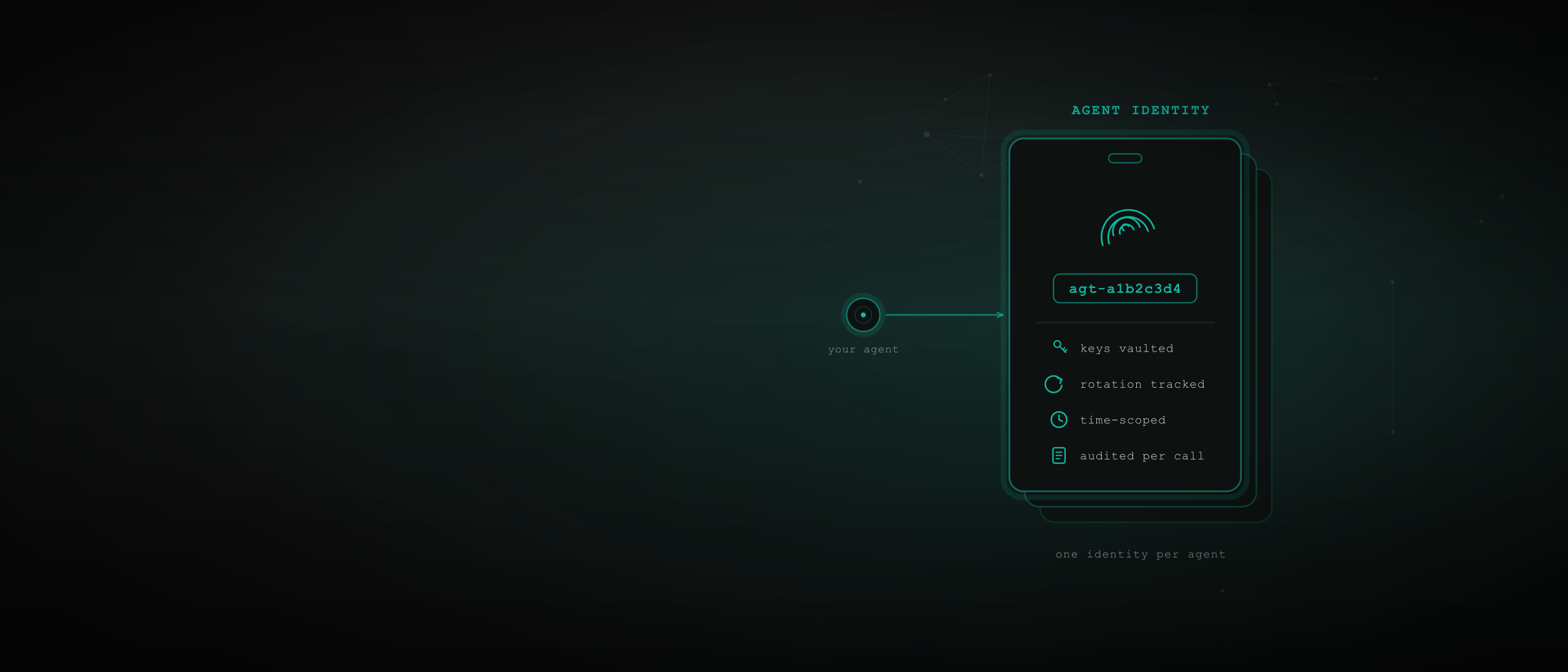
Tragentics treats every AI agent as a non-human identity from the moment you register it: the agent gets an immutable permanent ID and its own access token, its keys live in an encrypted Credential Vault it never holds, its credential lifecycle is tracked, and every call is audited against its identity.
What makes an AI agent a non-human identity?
On Tragentics, an agent is a first-class identity, not a line in a config file. Registration mints an immutable permanent ID (agt-) — the agent's fingerprint — plus its own access token, and you can add an Ed25519 agent identity it uses to prove it is itself on every call.
That identity is built to outlive everything around it. Rename the agent, archive it, restore it — the permanent ID never changes. Delete the agent, and the ID still survives inside audit references, so "which identity did this" keeps its answer even after the identity itself is gone.
The IAM world has already reclassified your agents. Palo Alto Networks' 2026 Identity Security Landscape counts 109 machine identities for every human one — 79 of them AI agents. And the Cloud Security Alliance's May 2026 whitepaper is blunt about what kind of identity an agent is:
"AI agents are not passive credential holders; they are autonomous actors that acquire permissions dynamically at runtime, spawn sub-agents, invoke external APIs, write and execute code."
How do you inventory AI agent identities?
On Tragentics, registration is the inventory. Every agent enters your fleet through the same door — named, fingerprinted with a permanent ID, and searchable from the moment it exists. Nothing joins anonymously.
This inventory can't drift, because the ID isn't a spreadsheet entry — it's the identifier every part of the platform actually uses: invites, discovery cards, board listings, audit logs. When one identifier is the operational key everywhere, your inventory and your reality are the same list.
That's the step-one control most non-human identity management programs are missing. The CSA found that more than 16% of organizations do not track the creation of AI-related identities at all — and an identity that was never recorded can't be scoped, rotated, revoked, or audited.
Should every AI agent have its own credentials?
Yes — and on Tragentics it's the default, not a discipline you enforce. Each agent carries its own scoped keys in the encrypted Credential Vault, injected server-side at call time; the agent never holds them, and no two agents ever need to share one. Per-agent keys are also what make every action attributable — the reason to stop sharing API keys across agents in the first place.
The credential lifetime can shrink as far as you want it. OAuth2 for AI agents swaps static keys for short-lived tokens exchanged just in time. Time-scoped credentials go further: business-hours mode limits access to chosen days and hours in your timezone, and scheduled-only mode unlocks the credential just around a schedule trigger.
Outside a configured time-scope window, calls are rejected before credential injection even happens.
The exposure this closes is live right now. Palo Alto's follow-up analysis puts AI agent adoption at 99% of organizations, with 40% of those agents already reaching organizational data — most on credentials nobody scoped to a single identity.
How do you rotate and revoke an AI agent's credentials?
On Tragentics, rotating a key produces evidence: every rotation lands in a fleet-wide credential rotation history — timestamp, agent, who initiated it — with the key values themselves never stored. And revoking is by name: revoke the agent, and that identity is out.
The per-agent rotation timeline turns the non-human identity lifecycle into something you can see. Every credential change for one identity sits on its own axis — API key, OAuth2, time-scoping — so rotation frequency is visible at a glance, and agents that have not rotated credentials recently identify themselves.
Here is the industry's scorecard on this exact capability: only 37% can revoke an AI agent's credentials.
Two-thirds of organizations cannot fire a non-human identity they created.
NHI program requirement | Without per-agent identity | On Tragentics |
|---|---|---|
Inventory | Creation goes untracked — 16%+ of orgs record nothing | Permanent ID minted at registration, searchable fleet-wide |
Scoped credentials | Shared keys pasted across configs | Per-agent keys, encrypted in the Credential Vault, injected server-side |
Rotation | Unrecorded, unmeasured | Fleet-wide history + per-agent timeline; values never stored |
Revocation | Only 37% can revoke an agent's credentials | Revoke by name; time-scoped windows close access automatically |
Per-identity audit | 30% have immutable agent logging | Metadata-only trail per permanent ID, survives deletion |
Can you audit each non-human identity separately?
Yes. Tragentics records every call an agent makes or receives against its permanent ID in a metadata-only audit trail — caller, target, timing, status — so each identity carries its own history, and the record survives even the agent's deletion.
The two guarantees stay separate, and both serve you here. The content-blind relay never reads payloads in transit; the metadata-only audit trail never stores them. You get per-identity accountability — the core demand of AI agent security — without building a payload archive that becomes its own liability.
The industry baseline makes the case: only 30% of organizations report immutable audit logging for agent activities. When one agent misbehaves, most shops cannot reconstruct what that single identity did. Yours can — by permanent ID.
Frequently asked questions
What is a non-human identity?
A non-human identity is any identity that belongs to software rather than a person — service accounts, workloads, CI/CD pipelines, and AI agents. On Tragentics, every registered agent is a non-human identity by construction: it gets an immutable permanent ID, its own access token, and its own vaulted credentials the moment it exists.
What is the difference between machine identity and non-human identity?
Mostly vocabulary: machine identity is the overlapping infrastructure term, non-human identity the broader IAM umbrella covering service accounts, workloads, and AI agents. The population is the same — and it is growing fastest at the agent end, with machine identities outnumbering humans 109 to 1 and 79 of those 109 being AI agents.
Are AI agents non-human identities?
Yes — the fastest-growing kind, and the least governed. The Cloud Security Alliance describes them as autonomous actors that acquire permissions at runtime, not passive credential holders. That is why Tragentics gives each agent a real identity — permanent ID, scoped keys, tracked rotation, per-identity audit — as the registration default.
How do I revoke an AI agent's access?
On Tragentics, by name: revoke the agent and that identity is out, and its keys stay locked in the Credential Vault — never held by callers, so there are no leaked copies to chase. The rotation history records the lifecycle. Time-scoped windows go further, closing access automatically outside the hours you approve.
Do AI agents need identities separate from service accounts?
Yes. An agent acting through a shared service account is invisible — every action attributes to the account, not the agent. A per-agent identity makes each call attributable to the one agent that made it, which is why Tragentics registers every agent with its own permanent ID and credentials instead of letting a fleet share one.