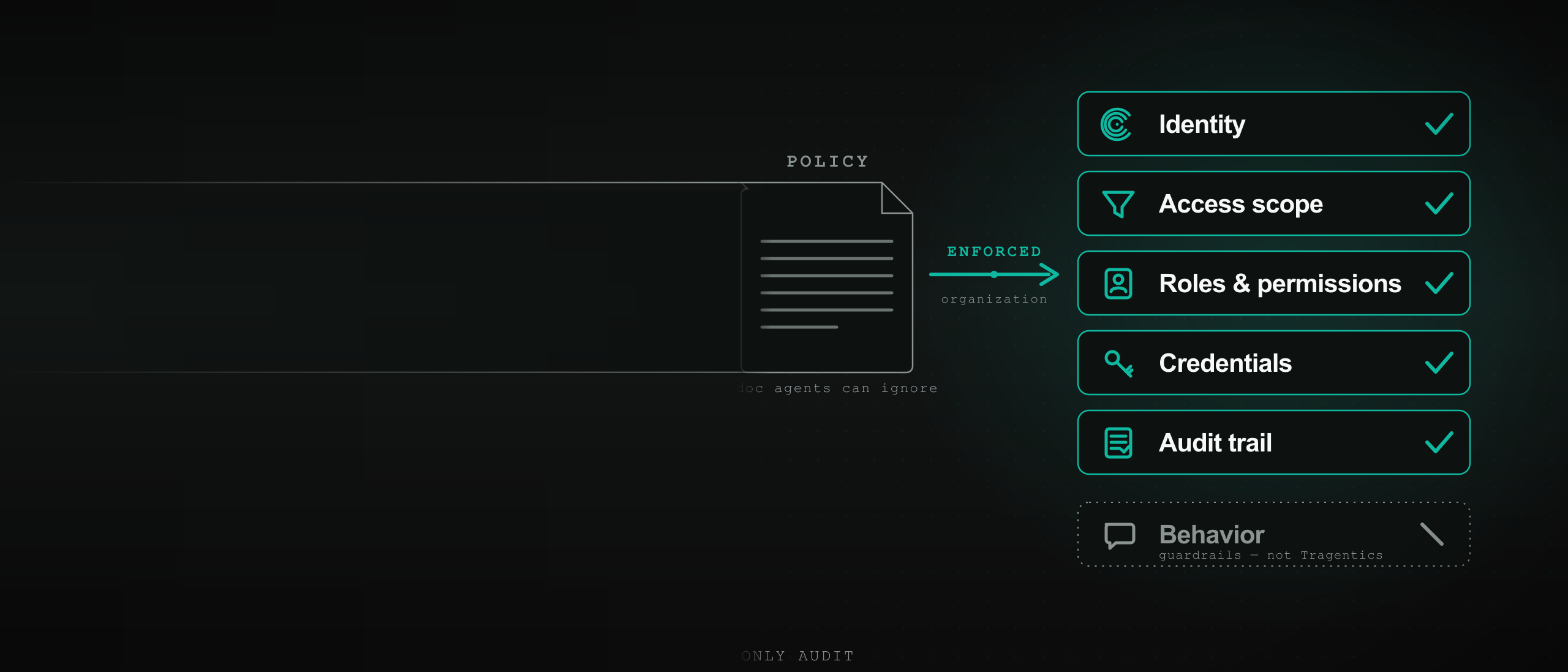
AI agent governance is the practice of controlling what autonomous AI agents may do, with which credentials, and under whose authority — and proving it — as they act and interact at scale. It spans two layers: the policy that says what should govern agents, and the enforcement that actually constrains them.
Tragentics governs the enforcement layer. As the AI agent security platform, it gives every agent an identity, scopes who may do what with which credential, and records a metadata-only audit trail — so governance becomes controls you can click, not a document you file.
What is AI agent governance?
AI agent governance is how an organization controls autonomous agents — what they can do, how, and under whose authority — while keeping the autonomy that makes them useful. It's the agent-era successor to AI governance: model governance asks whether a model is safe to ship; agent governance asks whether a deployed agent is safe to act.
The shift is delegation. A traditional application does what its code says; an AI agent pursues a goal, choosing which tools to call and in what order, so its exact actions aren't predictable from the initial instruction (Holistic AI). Governance therefore moves from a model's capabilities to the parameters of delegation — what you let an agent reach, with which credentials, and how you hold it accountable, which IAPS's field guide frames as governing the conditions of autonomous action. As agents move from single assistants to fleets that call each other, that becomes an operational problem, not a philosophical one.
Policy vs. enforcement: the half of governance nobody operationalizes
Most agent-governance guidance stops at policy — the rules that should govern agents — and never reaches enforcement, the controls that actually constrain them. That gap is the whole problem.
A governance policy an agent can ignore is not governance.
The public material is strong on the policy layer. Think tanks and vendors map the ethics of delegation, oversight models, and risk taxonomies — necessary, foundational, and almost entirely non-operational. What a platform team needs on Monday is different: the specific control that answers each governance question, and a record proving it held. Sorting governance by its underlying question makes the enforcement layer concrete.
Table 1 — What agent governance must control, and what actually enforces it
Governance question | The control it needs | Plane | On Tragentics |
|---|---|---|---|
Who is this agent? | Verifiable identity | Infrastructure | A permanent |
What may it reach? | Authorization & access scope | Infrastructure | Explicit connections plus per-member access scopes |
With which credential? | Credential authority | Infrastructure | Injected from the Credential Vault; the agent never holds it |
Who may do what? | Roles & permissions | Infrastructure | Admin/member roles plus twelve scoped permissions |
Can you prove it happened? | Auditability | Infrastructure | A metadata-only audit trail |
What may the agent decide or say? | Behavior control | Behavior | Guardrails — deliberately not Tragentics |
The last row is deliberately not ours: governing what an agent decides or says is the behavior plane's job, and it needs a tool built to read the payload. The other five are infrastructure controls — enforceable without reading a byte of your agents' traffic.
The two planes of agent governance
Agent governance splits along the same fault line as AI agent security itself: a behavior plane and an infrastructure plane, with opposite requirements. Behavior-plane governance controls what an agent may decide and say — tool allow-listing, output limits, prompt-injection defense — and must read the payload to do it. Infrastructure-plane governance controls what an agent is and touches — its identity, its access, its credentials, and the audit record — and is done best without reading the payload at all.
Both are governance; they aren't interchangeable. You can't permission your way out of a jailbroken prompt, and no guardrail can prove which agent made a call or stop it from reaching a system it was never granted. A serious program runs both planes and assigns each control to the layer built for it. Tragentics owns the infrastructure plane, end to end.
How Tragentics turns governance policy into enforced controls
Tragentics turns governance from a document into enforced controls by making the organization the operating boundary for your agents. One admin groups agents, networks, and the surfaces of secure orchestration — schedules, pools, and broadcasts — plus logs under a single organization, then invites people into it with explicit permissions and explicit access scope, without giving away full account access. Invites carry their permissions and scope up front, expire in an hour, and are resend-capped, so onboarding is bounded by default. The account owner stays the owner; the organization adds the team-governance layer on top. Four primitives do the enforcing.
Roles: admin and member
Tragentics uses a deliberately simple two-role model, because governance you can reason about beats governance you can't. An admin is the organization owner — full control over members, settings, resources, SSO, and admin transfer. A member is an invited user whose reach is bounded by permissions and access scope (members and roles). Admins never switch into their own organization context — their personal view already shows everything they own — so context switching exists for members only. Two roles are the whole model; there's no sprawling role matrix to misconfigure.
Permissions: twelve scoped capabilities, deny by default
Each member carries a set of feature permissions, and anything not granted is denied by default. The twelve gate the operational surfaces a governance policy actually cares about: creating agents and managing them, managing networks, managing credentials, managing schedules, pools, broadcasts, and protocols, managing the Canvas, managing invites, and viewing analytics and audit logs. A member gets exactly the actions their job needs and nothing more — least privilege applied per person, not per account. It's the same posture as zero trust for AI agents: grant explicitly, deny by default.
AI agent access control: scoped visibility for the fleet
AI agent access control decides which agents and networks a person can even see and touch — and on Tragentics, members don't automatically see everything. A member's access scope is either all resources in the organization, or limited to specific networks or specific agents, with a network scope cascading to the agents inside it. Permissions and scope compose: scope decides which resources are in view, permissions decide what a member may do with them. The full operational walkthrough — the four controls, the invite flow, and offboarding — is in how to control who can access your AI agents.
Table 2 — Access scopes: what a member can see and manage
Scope | The member can see and manage | Set at |
|---|---|---|
All resources | Every agent and network in the organization | Invite, or later |
Limited — network(s) | Only assigned networks and the agents inside them | Invite or access edit |
Limited — agent(s) | Only individually assigned agents | Invite or access edit |
Personal vs. organization context
Every member has two views — their personal space and the organization they've switched into — and the active context decides what they see and where new resources land. An agent created while switched into an organization belongs to that organization, not the person. Admins are the exception: they don't context-switch into their own organizations, so there's never ambiguity about who owns what.
How do you prove agent governance? The metadata-only audit trail
Governance you can't prove is just a promise. Tragentics records every routed call and every authorization decision as a metadata-only audit trail — caller and target identity, outcome, status, latency, byte counts, and a trace ID. The content-blind relay never reads the payload in transit, and the record never stores it, so you can show exactly who did what, when, and whether it was allowed, without keeping a second copy of your agents' sensitive data. Inside an organization, audit-log visibility is itself a permission, so the evidence layer is governed like everything else.
Governance isn't compliance. A metadata-only audit trail supports the record-keeping behind rules like the EU AI Act's Article 12 — it's evidence you can hand an auditor, not a certificate that makes you compliant.
Do you need SSO to govern AI agents?
You don't need SSO to govern agents — roles, permissions, access scope, and the audit trail do the governing — but at enterprise scale SSO governs the front door: who can become a member at all, tied to a verified business domain. Tragentics supports organization SSO as an add-on: an admin configures a SAML provider against the company's domain, and the login page can recognize users on that domain and route them to SSO (SSO for organizations). The domain check is public and rate-limited — it only answers whether SSO is enabled for a domain, never exposing the organization behind it. Because that identity support depends on the deployed auth stack, treat SSO as an enterprise add-on rather than a default.
Governing multi-team and multi-tenant agent fleets
One account can govern more than one organization. An admin can hold several organizations at once — each its own operating boundary with its own members, permissions, scopes, and audit trail — which is how a platform team separates business units, or how an MSP or consultancy keeps each client's agents, credentials, and logs isolated from the others. Every administrative action resolves against one specific organization, so there's no cross-tenant bleed: managing one client's fleet never touches another's.
Where infrastructure governance ends
Infrastructure governance ends at the payload. Tragentics governs an agent's identity, its access, its credentials, and its audit trail — the who, what, with-which-key, and prove-it — but it does not govern what an agent decides to do with the access it has. Steering an agent's reasoning, catching a poisoned instruction, filtering a harmful output: those are behavior-plane controls, and they belong to guardrail tooling built to inspect the payload. Map both to a framework and the division is clean — NIST's AI Risk Management Framework "Govern" function and its record-keeping expectations, and the EU AI Act's Article 12 traceability records, are served by the infrastructure plane's identity, access, and metadata-only audit; the behavior plane covers the rest. Governance is complete only when both planes are covered.
Frequently asked questions
What's the difference between AI governance and AI agent governance?
AI governance covers models and AI systems broadly — is this model safe and fair to ship? AI agent governance is narrower and more operational: because an agent acts, it governs the conditions of that action — the agent's identity, what it may reach, which credentials it uses, and the audit trail proving what it did. It governs delegation, not just the model.
What is AI agent access control?
AI agent access control decides which agents, networks, and resources a person or agent may see and act on. On Tragentics it has two parts: a member's access scope (all resources, or limited to specific networks or agents) and feature permissions (which actions they may take). Scope decides what's in view; permissions decide what you can do with it.
How do you enforce least privilege for AI agents?
Give each person and agent only the access the task needs. On Tragentics, a member's scope can be limited to specific networks or agents, twelve feature permissions are denied unless granted, and agent connections are explicit — an agent reaches only what it's connected to. Nothing is all-access by default, so over-permissioning takes a deliberate choice.
Do you need SSO to govern AI agents?
No. Roles, permissions, access scope, and the audit trail do the governing. SSO governs the front door — who can become a member, tied to a verified business domain — and Tragentics offers it as a per-organization SAML add-on. It's valuable at enterprise scale for identity federation, but it's layered on top of governance, not a prerequisite for it.
How do you prove AI agent governance to an auditor?
With a metadata-only audit trail. Tragentics records every call and authorization decision — caller and target identity, outcome, status, latency, and a trace ID — while the content-blind relay never reads the payload and the record never keeps it. You get a durable record that supports your record-keeping obligations, and that shows who did what and whether it was allowed, without exposing your agents' data.
Can one admin govern agents across multiple teams or client organizations?
Yes. One account can admin multiple organizations, each a separate operating boundary with its own members, permissions, access scopes, and audit trail. It's how a platform team splits business units, or an MSP keeps each client isolated. Every administrative action resolves against one specific organization, so managing one fleet never touches another's.
Does using Tragentics make me EU AI Act compliant?
No — and no tool should claim to. Tragentics supports the record-keeping and traceability obligations behind rules like the EU AI Act's Article 12 by producing a metadata-only audit trail of every agent call, automatically. Compliance is a program you run; the audit trail is evidence that supports it. Tragentics gives you the record, not a certificate.
Can a member see every agent in the organization by default?
No. Visibility is scoped, not automatic. A member sees everything only if their access scope is set to "all"; otherwise they're limited to the specific networks or agents assigned to them, and any feature they haven't been granted is denied. Scoped visibility is the starting point, so a new member sees the minimum until you widen it.