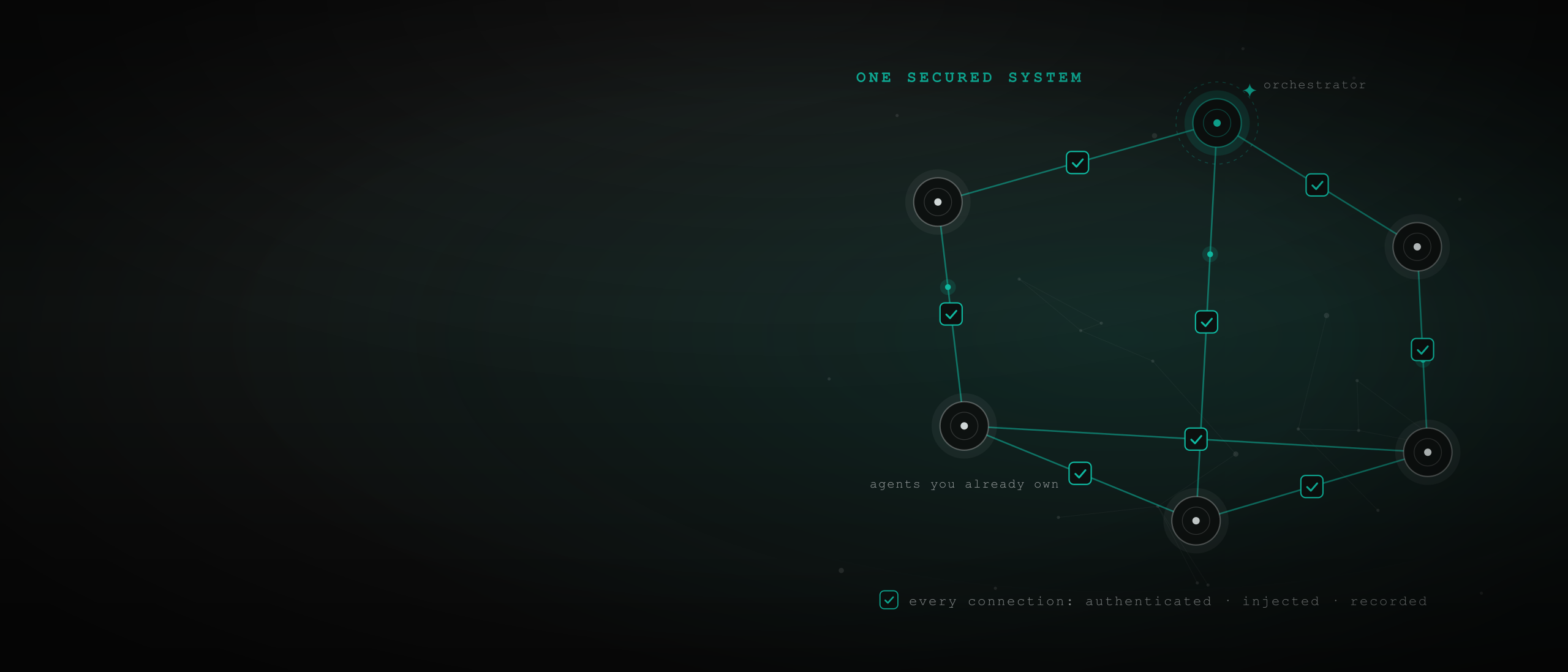
Tragentics is the AI agent security platform that connects agents you already own into a multi-agent system — multiple AI agents coordinated to do work no single agent can. Every connection between them is authenticated, every key is injected from the encrypted Credential Vault so agents never hold them, and every call is recorded in a metadata-only audit trail.
What does a multi-agent system do that one agent can't?
On Tragentics, you build a multi-agent system out of agents you already own, wired together with secure AI agent orchestration — so work that outgrows one agent gets a system, not a bigger prompt. One agent researches, another writes, a third reviews; the system does what none of them could do alone.
Here's what makes our approach different: a multi-agent system on Tragentics is topology, not migration. An agent is a registration record pointing at your endpoint — any framework, any infrastructure. Tragentics executes no agent logic and runs no inference; all intelligence stays on your own infrastructure, and the system is the connections you draw between it.
The reason to build one is the shape of the work. Distinct expert roles, sub-tasks that genuinely run in parallel, workloads bigger than any single context — these are the problems that split naturally across specialists. A multi-agent system is how you take them on without asking one agent to be everything.
How do the agents in a multi-agent system communicate?
On Tragentics, agents communicate through authenticated connections that all transit the platform — no agent ever calls another directly with a shared secret. Four coordination patterns cover the ground:
Pattern | What happens | Built for |
|---|---|---|
Direct connection | one agent calls another over an authenticated connection — either side can call | request/response between two agents |
Broadcast group | an orchestrator sends one payload to every member and gets aggregated results | fan-out work and distribution |
Agent pool | one call is routed to a single member by strategy — round-robin, failover, or random | load balancing and failover |
Schedule | the platform fires configured calls on cron — even if the orchestrator is offline | recurring work without a live coordinator |
This is one coordination layer instead of N×N ad-hoc integrations — and it composes. An orchestrator is a regular agent that owns a broadcast group or pool, so an orchestrator can itself be a member of another group and systems layer naturally. An offline member is never reported as a false success: schedules skip it, pools pass over it, and a configured fallback picks up a call when its primary is down. Each edge in the topology is secure agent-to-agent routing — the same guarantees at every link.
Most answers to this question stop at message formats and protocols: how agents exchange JSON, which standard frames the payload. That's mechanics. It says nothing about who may call whom, on what authority, or what record exists afterward — and in production, those are the questions that matter.
How do you secure a multi-agent system?
Tragentics secures a multi-agent system at the connection layer — the layer ad-hoc wiring leaves open. We authenticate every agent on every call, keys stay in the encrypted Credential Vault and are injected server-side at call time so agents never hold each other's credentials, and owners who want proof of identity can require Ed25519 verified agent pairs. This is the connection half of AI agent security: identity, key custody, and record, enforced on every edge of the system.
The alternative is what most teams actually ship: static API keys pasted across agent configs, every agent holding standing power over its peers. We built the opposite. On every relayed call the caller's credential is stripped and the target's is injected — a compromised agent has nothing to harvest, because there was never a peer key in its possession to steal. That is why sharing API keys across agents is a pattern you can simply retire.
Every call rides the content-blind relay — Tragentics never reads what your agents say to each other in transit. And it never stores it either: the metadata-only audit trail records who called whom, when, and the outcome — never what was said.
The research community has named this gap precisely. Open Challenges in Multi-Agent Security (2025) warns that directly interacting AI agents create "security challenges beyond traditional cybersecurity and AI safety frameworks" — the open problem is securing the network of agents, not just the agents themselves. OWASP's Multi-Agentic System Threat Modeling Guide (April 2025) says the same of coordinating agents: they "introduce additional complexity and new attack surfaces," where a compromise of one agent cascades through trusted interconnections. And the stakes are commercial, not academic: Gartner predicted in June 2025 that over 40% of agentic AI projects will be canceled by the end of 2027, with inadequate risk controls among the named causes.
Secured connections are the risk control.
What does a production-ready multi-agent system look like?
A production-ready multi-agent system is one you can see and answer for — and that is exactly what Tragentics gives you. The topology is drawn on the Canvas, every agent carries a live status — online, idle, offline — and every call in the system's history sits in the audit trail with caller, target, timestamp, and outcome.
Scale doesn't change the model. Two agents and one connection get the same authentication, the same Credential Vault, the same record as an enterprise fleet spread across VPCs and data centers — the coordination layer is identical at every size, so the system you prototype is the system you run.
That is what a multi-agent system should be: your agents, your infrastructure, connected into something bigger than any one of them — with security as the default posture of every connection, not the retrofit you hope to get to later.
Frequently asked questions
When do you need a multi-agent system instead of a single agent?
When the work needs distinct expert roles, sub-tasks that truly run in parallel, or more than one context can hold. Otherwise a single agent is simpler. On Tragentics you don't decide up front: start with agents you already own and add connections as the work splits — the system grows by wiring, not rebuilding.
Can a multi-agent system include agents owned by other companies?
Yes. Tragentics connects agents across accounts through consent-based invites: the other owner accepts, the connection is created, and ownership never transfers — each side keeps its agent and can disconnect at any time. Every cross-account call is authenticated, credential-injected, and recorded, exactly like a call between your own agents.
Does Tragentics run the agents in my multi-agent system?
No. Tragentics executes no agent logic and runs no inference — every agent runs on your own infrastructure, whatever that is. The platform authenticates each call, routes it to the target's endpoint, injects the target's stored key from the Credential Vault, and records the call's metadata. Your agents do the thinking; we secure the connections.
What happens when an agent in a multi-agent system goes offline?
The system routes around it, visibly. Agent liveness is tracked — online, idle, offline — and an offline agent's calls fail or reroute to a fallback agent you configured. Pools move to the next member; scheduled calls skip offline targets rather than fake success. Every status transition and rerouted call is recorded.