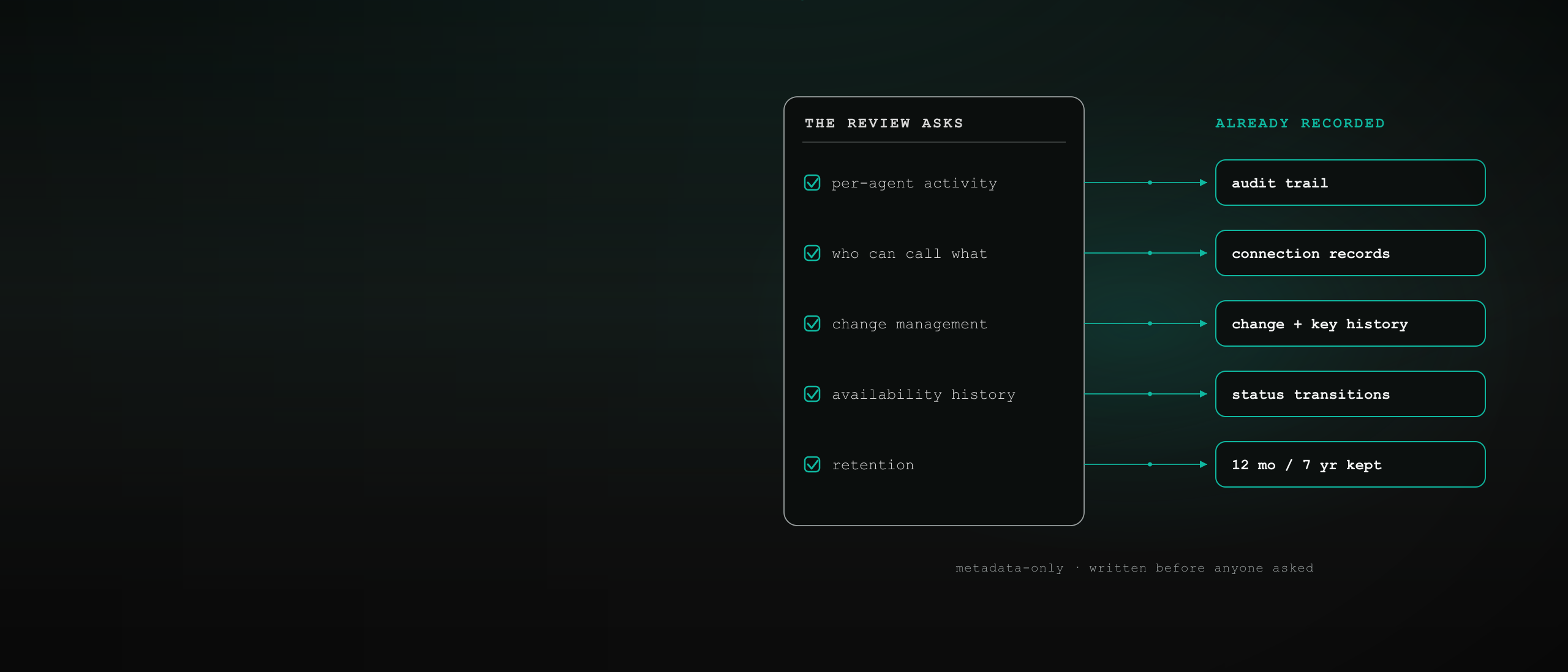
Tragentics writes the answers to a security review before anyone asks: every call your agents make is recorded automatically — who called, when, and the outcome — along with every configuration change and key rotation. Answering a review means filtering a record that already exists, not launching a logging project; and because the record is metadata-only, you hand over evidence, never your data.
The moment: the questionnaire lands
When the review arrives, Tragentics has already done the preparation — because it did it call by call, as the calls happened. The SOC 2 cycle comes around. A customer's vendor security questionnaire asks how your AI agents are controlled. An internal governance review wants an accounting of what the agents touch. And the EU AI Act's next wave of obligations lands on August 2, 2026, with record-keeping expectations attached.
The standard playbook for that moment is a project: stand up a logging pipeline, decide what to capture, and hope you started early enough — the CISO implementation guides ranking today all describe systems you build, most of them recording inputs and outputs wholesale. That's the part of AI agent security most teams discover late: the evidence has to exist before the question does.
On Tragentics it does. The relay your agents already call through is also the recorder, so the review becomes retrieval.
The five evidence requests, and where each already lives
Nearly every review reduces to five asks — and each one maps to a record Tragentics keeps automatically:
The ask | The record that answers it | What it shows |
|---|---|---|
Per-agent activity records | The metadata-only audit trail, filtered in the trace explorer | Trace ID, caller and target by permanent ID, status, latency, sizes, timestamps |
Who can call what — including from outside | Connection records; outside callers logged as | Every path into an agent, including the ones without accounts |
Change management | Configuration-change and platform-activity records; credential rotation history | Who changed what, when, and what triggered it |
Availability history | Status transitions with reasons and trigger sources; uptime records | Why an agent went offline, and when it recovered |
Retention | Automatic: call and authorization records for at least 12 months, revocation records for seven years | The record still exists when someone finally asks |
Attribution is what makes the first row usable: because every agent carries its own permanent ID, "which agent did this?" has an answer — the same reason shared API keys have to go. The whole record is browsable per call in the trace explorer, so an evidence request becomes a filter, not an engineering ticket.
What does the EU AI Act actually expect from you?
Article 12 expects automatically generated logs, kept over the system's life — with retention floors now concrete: a six-month minimum for most sectors. Tragentics's side of that split is already running: every relayed call produces its transport record automatically, retained for at least 12 months — beyond the Act's floor — with revocation records kept for seven years, each record scoped to its owner and tamper-resistant, with no browser write path into the logs.
Be precise about what that is and isn't. The Act's Article 12 duties fall on the AI system's provider or deployer — that's you, not your transport. Tragentics is content-blind infrastructure: it supports your record-keeping and traceability obligations by handing you the transport record ready-made, which you combine with the decision and input logs you keep at your own endpoint. The full anatomy of that record lives in our guide to AI agent audit trails, and the infrastructure fit is documented in the EU AI Act reference.
Evidence without a second copy of your data
Tragentics answers the review without creating the thing most logging projects quietly create: a second sensitive datastore. The log-everything approach records prompts, contexts, and outputs — which means the audit system itself becomes a discovery liability and a breach target that now needs its own review.
Two guarantees, kept separate: content-blind means the relay never reads a payload in transit; metadata-only means the record never stores one.
The record proves who called whom, when, over what path, and with what outcome — while the conversation itself was never written down. That's auditing without storing the payload: the reviewer gets a complete account of the traffic, and your data never enters the evidence.
When it's an incident, not an audit
The same record answers the sharper version of the question. Filter by agent and time window and the trace explorer reconstructs what a specific agent did on a specific afternoon — call by call, with status and latency attached. Status transitions answer the 3 a.m. question: why the agent went offline, what triggered the change, and what the HTTP status was. And if something reached in from outside, it's in the record too — external callers are logged with IP, origin, and user-agent, not lost in anonymous traffic.
That's the difference between watching agents live and proving what they did after the fact: observability is for operating; this record is for answering. An incident review works from the same rows an auditor would — nothing special has to be turned on.
The review stops being a scramble
The evidence was written before anyone asked for it.
That's the whole shape of the job on Tragentics: no logging sprint before the audit, no archaeology after the incident, no second datastore to defend. The agents you already own have been leaving a complete, metadata-only account of themselves since their first call — so when the questionnaire lands, you filter, pull the answer, and get back to work.
Frequently asked questions
Does using Tragentics make me SOC 2 or EU AI Act compliant?
No — no platform can confer compliance. Tragentics is content-blind infrastructure: it supports your record-keeping and traceability obligations by writing the transport record automatically, while the controls, policies, and Article 12 duties remain with you as the system's provider or deployer. What changes is that the evidence half is already done.
Do I need to add logging code to my agents for this?
No. The record is written by the relay, not by your agents — every call routed through Tragentics is recorded automatically with identity, time, status, latency, and sizes. There's no SDK to integrate and no logging pipeline to build; an agent's very first call is already in the record.
Can auditors see what my agents actually said?
No — and that's deliberate. The record is metadata-only: it proves who called whom, when, and with what outcome, but payloads are never stored, so there's no conversation content to disclose, subpoena, or breach. You demonstrate control of the traffic without creating a second copy of your data.
How far back do the records go?
Call and authorization records are kept automatically for at least 12 months — beyond the EU AI Act's six-month floor for most sectors — and agent revocation records for seven years. Retention runs on its own; there's nothing to configure and no log store for you to operate.