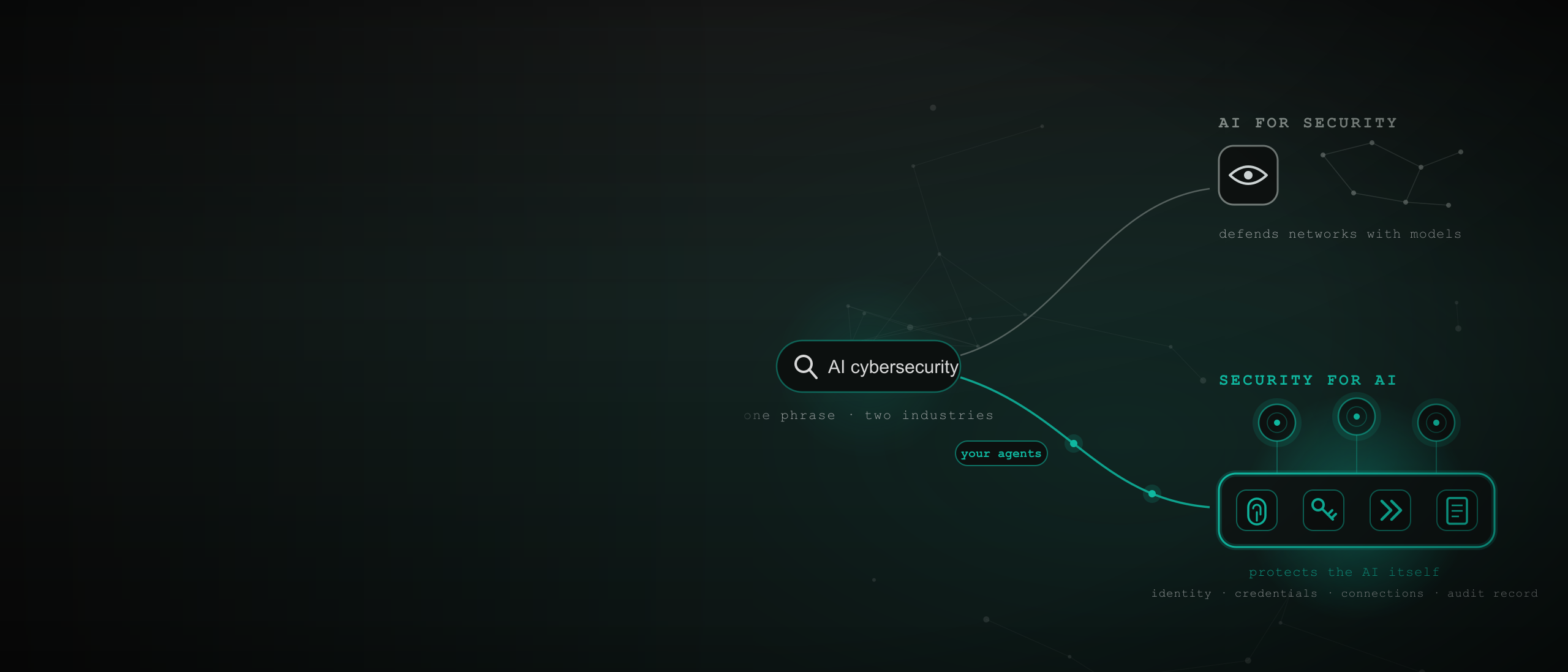
Tragentics sits on one side of this question. We are the AI agent security platform that secures the AI itself — every agent authenticated, keys injected from an encrypted Credential Vault, every call routed through a content-blind relay and recorded in a metadata-only audit trail. "AI for security" is the other industry — your agents need this one. Here's the map.
What's the difference between AI for security and security for AI?
Tragentics is a security-for-AI platform, full stop. We protect the agents you already own — their identity, their credentials, their connections — and nothing about us is "AI-powered defense." Tragentics runs no inference and executes no agent logic, so there is no model inside our platform for the phrase to blur.
That clarity matters because "AI cybersecurity" is two industries wearing one name, and vendors on both sides use it interchangeably. Security teams researching the split get careful explainers from Tenable and HiddenLayer — both worth reading, both stopping at models and pipelines. Here is the whole split in one table:
Which side | What it does | What it protects | Typical tools | The question it answers |
|---|---|---|---|---|
AI for security | Uses AI models to defend your infrastructure — detect threats, triage alerts, hunt anomalies | Networks, endpoints, email, cloud workloads | AI-powered detection and SOC platforms | "Can AI help my security team?" |
Security for AI | Protects the AI systems you deploy from compromise | Models and pipelines — and for agents: identity, credentials, connections, the audit record | Guardrail platforms on the behavior plane; Tragentics on the infrastructure plane | "Who protects the AI I'm deploying?" |
If you typed "AI cybersecurity" because you're deploying agents and something needs to protect them, you're on the right side of the table. Keep reading.
What does security for AI mean when your AI is agents?
Tragentics secures the agent layer specifically. Every agent registered with us gets a permanent ID and an Ed25519 identity that signs its calls, its keys live encrypted in the Credential Vault instead of inside the agent, and every connection it makes is explicit, revocable, and recorded. That is what "security for AI" means when the AI does things instead of just saying things.
The published explainers stop one level too high. Securing a model means protecting training data and weights. But an agent is a model with hands — it holds identity, touches third-party APIs, and acts across systems, which makes the infrastructure around it the asset: who it is, what keys it can use, what it may call, and what record survives. That is the infrastructure plane of AI agent security, and it splits cleanly from the behavior plane — the guardrail tools that inspect what agents decide and say. You need both planes; we build one of them, completely.
The population you're protecting is already the majority of your identities. Machine identities outnumber human ones 109 to 1, and 79 of those 109 are AI agents, per the 2026 identity security landscape report. Security for AI isn't a niche of your security program anymore. It's most of it.
Do AI-powered security tools protect your agents?
No — and Tragentics exists to cover exactly what they don't. We authenticate every agent, inject keys from an encrypted Credential Vault so agents never hold them, route every call through a content-blind relay, and record a metadata-only audit trail. Those four jobs are the gap between "our SOC uses AI" and "our AI is secured."
An AI-powered detection platform watches networks and endpoints with models. It does not issue your agent an identity, does not hold its API keys, does not decide which agent may call which, and cannot produce the per-call record of what your agents did. Different asset, different tool.
The wound it can't close is the leaked key. GitGuardian counted 28.65 million secrets exposed on public GitHub in a year — 24,008 of them in MCP config files — and one stolen OAuth integration reached 700+ organizations' data in the Salesloft Drift breach. No detection model un-leaks a key. A vault the agent never holds means there's nothing in the agent to leak.
Why isn't Tragentics itself AI-powered?
Tragentics runs no inference and executes no agent logic — by design, not limitation. Your agents' traffic passes through us byte-for-byte.
Content-blind means we never read payloads in transit; metadata-only means we never store them in the record. Two guarantees, never merged.
A security layer that analyzes your agents' traffic has, by definition, made itself a second copy of your most sensitive data. That's the honest trade of the behavior plane — inspection is the product — and it's why the content-blind relay refuses the job.
The layer that carries everything should read nothing.
What should you look for in security for AI agents?
Tragentics ships the infrastructure plane as one system, not four projects: agent identity, the Credential Vault, the content-blind relay, and the metadata-only audit trail in a single platform, protocol-agnostic across MCP, A2A, ACP, OpenAI, ANP, and DID traffic — working today with the agents you already own. The alternative is wiring a vault, an identity broker, a gateway, and a logging pipeline together yourself and owning every seam.
Keep your behavior-plane tools; guardrails watch what agents say, and that job is real — the full tools map shows how the categories fit together. But the next time a search box offers you "AI cybersecurity," you'll know which side of the phrase you're standing on. Your agents live on the second side — and giving them a home there starts with a free 7-day trial, no credit card, at tragentics.com.
Frequently asked questions
Is AI cybersecurity the same as AI agent security?
No. "AI cybersecurity" is an umbrella phrase covering both AI-powered defense tools and the protection of AI systems. AI agent security is the second branch applied to agents specifically — identity, credentials, transport, and audit for autonomous systems that call real APIs. Tragentics is the integrated platform for that branch's infrastructure plane.
Can one platform do both AI for security and security for AI?
You shouldn't want one to. AI for security works by analyzing your traffic and behavior with models. The infrastructure plane as Tragentics builds it is content-blind — it works by never reading your data at all. The two postures contradict each other. Run both, but run them as separate tools.
What's the difference between AI security and regular cybersecurity?
The asset changes. Regular cybersecurity protects human users, devices, and networks. AI security protects non-human actors — models and agents — whose risks are different: stolen agent keys, impersonated callers, untraceable actions. Tragentics gives each agent a permanent identity, keys it never holds, and a metadata-only audit trail built for exactly that population.
Do I still need my existing security stack if my agents are secured?
Yes. Tragentics secures what your agents are and touch — identity, credentials, routing, audit. Your endpoint protection, network defense, and any AI-powered detection keep doing their jobs on your infrastructure, and guardrail tools remain the right call for prompt-level threats. The planes are complementary; none of them replaces the others.