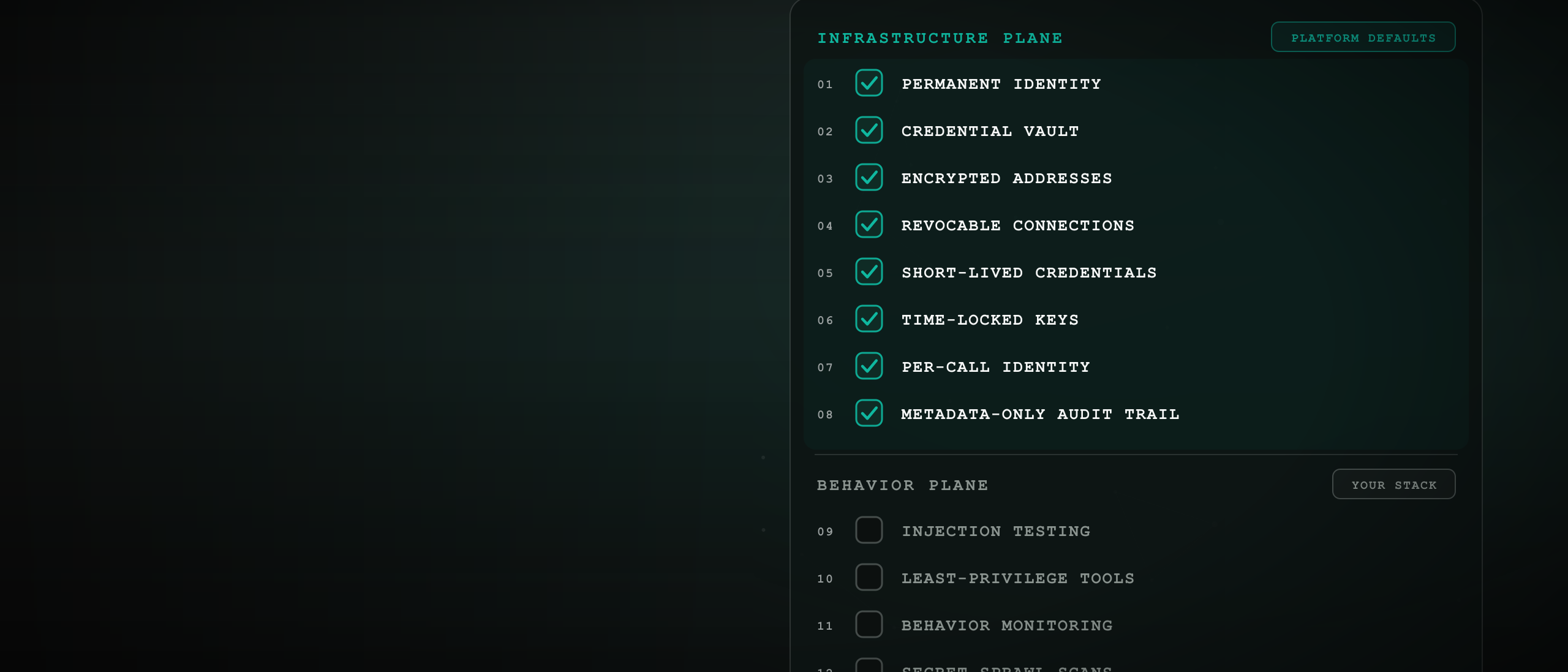
Securing AI agents takes twelve concrete steps across two planes: an infrastructure plane — permanent identity, keys held in an encrypted Credential Vault, revocable connections, per-call signing, a metadata-only audit trail — and a behavior plane of injection testing, tool scoping, and monitoring. Tragentics ships the first eight as platform defaults; this checklist covers all twelve.
Which layer does each step secure?
Tragentics secures the infrastructure plane of AI agent security — what your agents are and touch: identity, credentials, transport, and audit. The behavior plane — what agents decide and say — belongs to testing and guardrail practice, and an honest checklist covers both without pretending one tool does it all.
The split is how you avoid buying the same protection twice. Behavior tools have to read prompts and outputs to do their job; Tragentics is content-blind by design and never reads yours — the two planes complement each other, they don't compete. OWASP's Securing Agentic Applications guide draws the same boundary across its threat families.
Plane | What it secures | Typical controls | Steps |
|---|---|---|---|
Infrastructure (Tragentics) | What agents are and touch — identity, credentials, transport, audit | Credential Vault, revocable connections, per-call signing, metadata-only audit trail | 1–8 |
Behavior | What agents decide and say — prompts, tools, outputs | Injection testing, tool scoping, anomaly monitoring | 9–12 |
The 12-step checklist at a glance
Run down the list; the rest of the article earns each line.
- Register every agent with a permanent identity.
- Move every key into an encrypted Credential Vault.
- Encrypt the endpoint addresses, not just the keys.
- Replace shared keys with revocable connections.
- Prefer short-lived credentials via OAuth2 exchange.
- Time-lock keys that don't need 24/7 access.
- Turn on per-call identity for critical agents.
- Record a metadata-only audit trail on every call.
- Test against prompt injection before production.
- Scope every tool to least privilege.
- Monitor behavior, not just infrastructure.
- Hunt secret sprawl everywhere agents live.
On Tragentics, steps 1 through 8 are how the platform already works — configuration, not construction. Steps 9 through 12 are practices we point you to honestly, because no relay can do them for you.
Secure the infrastructure plane (steps 1–8)
Tragentics ships this half of the checklist as defaults — every step below is live enforcement on the wire, not a policy document.
1. Register every agent with a permanent identity
We give every agent a permanent ID (agt-) and its own access token the moment you register it — an inventory you can authenticate, rate-limit, and audit by name. You can't protect what you can't count, and the count is running away: machine identities now outnumber humans 109 to 1, and 79 of those 109 are AI agents.
2. Move every key into the Credential Vault
No agent on Tragentics holds a raw key. Store a credential once and it lives in the Credential Vault, encrypted at rest with AES-256-GCM; at the moment of a call we inject it server-side, so your agent uses an API key it never sees. This step deletes the leak surface instead of patrolling it — 28.65 million new secrets hit public GitHub in 2025 alone, most of them hardcoded exactly where agents live.
3. Encrypt the endpoint addresses, not just the keys
Tragentics encrypts endpoint URLs the same way it encrypts keys, as part of the credential security model. Where your agent lives is reconnaissance data — an attacker who can't resolve your topology can't map an attack across it.
4. Replace shared keys with revocable connections
On Tragentics, granting access means creating a connection — a permission that says this agent may call that one — never handing over a credential. End the connection and access dies instantly, with nothing left in the wild to rotate; that mechanism is secure agent-to-agent routing.
Share permissions, not secrets — a key you never hand out is a key you can actually revoke.
Rotation, the old answer, measurably fails: more than 64% of the credentials that leaked in 2022 were still valid in January 2026.
5. Prefer short-lived credentials via OAuth2 exchange
Tragentics turns long-lived keys into short-lived ones for you: store OAuth2 client credentials instead of a static key, and we exchange them for a fresh access token at call time, cached in memory until just before expiry. Long-lived tokens are the proven kill chain — stolen OAuth tokens from one chatbot integration reached more than 700 organizations' Salesforce data in a single 2025 campaign.
6. Time-lock keys that don't need 24/7 access
Tragentics lets a credential work only when it should: business hours in your days, hours, and timezone — or a 60-second window after one of the agent's own schedules fires. A stolen connection at 3 a.m. simply doesn't work, and the refusal spells out why.
7. Turn on per-call identity for critical agents
At the top of the zero-trust dial, an agent signs every call it makes with a private Ed25519 key and forms verified pairs with its peers — so a stolen token alone stops being enough. The mechanics live in Ed25519 agent authentication; turn it on for the agents that touch money, production, or customer data, and leave the floor for the rest.
8. Record a metadata-only audit trail on every call
Every call through Tragentics writes one audit line — caller, target, outcome, duration, byte sizes — and never the payload. You get evidence without a second sensitive datastore: a trail that supports your record-keeping obligations without becoming the next thing you have to protect.
Secure the behavior plane (steps 9–12)
The other half of the checklist governs what your agents decide — and honesty matters here. Tragentics never reads your payloads, so these steps belong to your testing and tooling, not to us.
9. Test against prompt injection before production
No platform stops prompt injection — Tragentics limits what a confused agent can leak, and testing limits how often it gets confused. Red-team every agent before deployment and again after material changes to prompts, tools, or models, following OWASP's AI Agent Security Cheat Sheet.
10. Scope every tool to least privilege
Tragentics scopes what an agent can reach on the wire — explicit connections, rate limits, time-locked keys. Inside the agent, tool scope is your lever: grant the minimum tools each task needs, separate tool sets by trust level, and require explicit authorization for sensitive operations. Over-permissioned tools turn one injected prompt into a systems compromise.
11. Monitor behavior, not just infrastructure
Track token spend, tool-call sequences, and per-agent anomalies. Tragentics hands you the metadata-only call record; behavior monitoring reads the content — which we never do, by design. Run both and each covers what the other can't see.
12. Hunt secret sprawl everywhere agents live
Scan repos, configs, and agent files for keys that never made it into a vault. Tragentics refuses secrets pasted into its own free-text fields — your pipeline should be as strict.
GitGuardian found 24,008 secrets exposed in MCP configuration files — your agent's own config is now a leak surface. Scan it like source code.
What a secured fleet looks like
On Tragentics, the first eight steps are the starting posture, not a project: register the agent, paste the key once, and the vault, the relay, and the audit trail are already running. Nothing to deploy, nothing to wire up.
From there the dial climbs as each agent earns it — a time-lock for the key that shouldn't work at night, per-call signing for the agent that touches production.
That's the finished picture: a fleet of agents that prove who they are, use keys they never hold, and leave evidence without leaving payloads. Work steps 9 through 12 with your testing and monitoring stack, and both planes are covered — no gaps, and nothing bought twice.
Frequently asked questions
How do I stop an AI agent from leaking its API key?
Remove the key from the agent entirely. On Tragentics, credentials live in an encrypted Credential Vault and are injected server-side at call time, so there is no key in the agent's context, config, or logs to leak — a prompt-injected agent can't reveal what it never held.
Do AI agents need their own identities?
Yes. Machine identities already outnumber humans 109 to 1, and 79 of those 109 are AI agents. Tragentics registers every agent with a permanent ID and its own access token, so you authenticate, rate-limit, revoke, and audit each one by name instead of sharing credentials across a fleet.
Can you secure AI agents without reading their messages?
Yes — the entire infrastructure plane works content-blind. Tragentics authenticates callers, injects keys, enforces limits, and records a metadata-only audit trail while forwarding payloads byte-for-byte, never reading or storing them. Only behavior-plane controls like guardrails and injection testing need content access, and those run in your stack.
Are MCP configuration files a security risk?
Yes — treat them like source code. GitGuardian found 24,008 secrets exposed in MCP configuration files, a new and largely unmonitored leak surface. Keep credentials out of agent configs entirely: store them in the Credential Vault, and scan every config and repo for key patterns before they ship.